Diplomacy
Arunachal’s Restless Frontier: Why the India-China Border Is Heating Up Again
By Sameer Hussain |
From a line drawn in 1914 to a standoff at Taksing in 2026, the eastern…




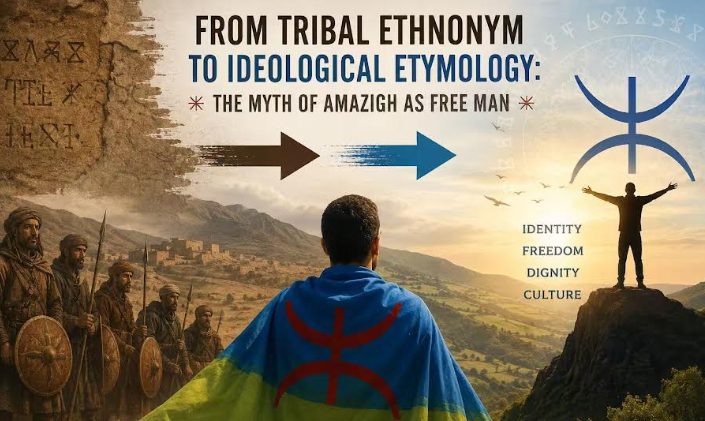
Ancient North African sources already attest to a widespread ethnonym built on the Mazik stem, appearing in multiple variants such as Mazices, Mazaces, Mazax, and related forms. These designations were used to refer to tribal groups that existed in different parts of ancient Roman North Africa especially Mauretania Caesariensis and Mauretania Tingitana corresponding to present-day central and western Algeria and Northen Morocco (Desanges, 1962; Modéran, 2013). When used in Latin and late antique contexts, the term Mazices appears together with other names such as Mauri, Gaetuli, and Afri. In some cases, it would appear as if Mazices was a general term that referred to non-Romans in North Africa (Desanges, 1962). The epigraphical record also provides evidence to suggest that Mazik/Mazic could be used as personal names in ancient North Africa. In this regard, it is clear from these records that Mazik was not an ethnic term limited to few people since it was a well-distributed term in North Africa (Desanges, 1962; Modéran, 2013).
Within Berber historical linguistics, it has been proposed that this ancient ethnonym (Mazik) may be connected—at least at the level of long-term continuity or reinterpretation—to the modern form Amazigh (Amazigh), though such a link remains debated and is not reducible to a simple phonetic equation. What is more secure is that modern interpretations of Amazigh as inherently meaning “free man” or “noble man” are not supported by ancient attestations of the term Mazik, but rather reflect later semantic developments (Chaker, 2022). In other words, the “free/noble” interpretation is best understood as a secondary ideological extension rather than an inherited etymological core.
Synchronically, Amazigh is attested as a self-designation among several Berber-speaking groups, especially in central Morocco (Middle Atlas and parts of the High Atlas), where Imazighen has long functioned as an endonym for local communities. The Tuareg varieties provide further evidence of continuity and phonological development, with forms such as Amažǝgh, Amašǝgh, and Amahăgh, which are regular reflexes of an earlier northern form and demonstrate internal Berber sound change rather than external borrowing (Prasse et al., 1998). However, synchronically attested meanings vary considerably across regions, showing that the term is not semantically fixed.
In some Zenati varieties of the Gourara (Algerian Sahara), Amazigh may extend to meanings such as “lord,” “master,” or even “God” (Bellil, 2000). This semantic expansion is historically explicable. Saraharn oases were marked by strong social stratification, where the dominant warrior Berbers –who were white – enslaved the black farmers. The ethnonym “Amazigh” became associated with dominant landholding and warrior groups, in contrast to dependent or enslaved populations (Chaker, 2022). A comparable development is found in southern Tuareg societies, where Amazigh came to denote specifically the noble warrior stratum, excluding dependent or enslaved groups. In contrast, in Northern Tuareg regions –where enslaved populations were far fewer – the word Amahagh retained a more general ethnonymic meaning referring broadly to Tuareg populations, both the nobels and the slaves (Foucauld, 1952; Prasse et al., 1998). These patterns demonstrate that meanings such as “noble” or “free man” arise not from lexical inheritance but fromlocal sociopolitical structures that reanalyze ethnonyms through social hierarchy.
Therefore, the popular understanding of Amazigh today as a word that necessarily means “free/noble man” must be understood as a fairly modern resignification process and not a historical etymology. As Chaker (2022) explains, this is a kind of ideological “acclimatization,” in which the ethnonym, particularly since the late twentieth century, has been expanded to express a broader sense of cultural unity and political identity across the Berber-speaking world.
It is crucial to note, however, that the critical engagement with the term Amazigh in this context must not be perceived as an attempt to deny or reject the term itself, as well as its current relevance on cultural, social and political levels. On the contrary, both the current author and those who were referred to in this context recognize the key importance of the term Amazigh as an ethnonym that is a symbol of identity and continuity of tradition within the Berber communities. The purpose of this kind of distinction is exclusively analytical and consists in drawing the line between what can be proven through historical linguistic, philological and evidentiary research and what is constructed subsequently within the framework of other ideological, cultural or political contexts. In this respect, the current analysis corresponds to the basic idea of scientific research, which implies the need for the critical examination of any concept, term or narrative despite its current symbolic importance.
Academic research examining ethonyms must be objectively conducted without the need for an emotional bond and collective identity bias. It should instead rely on the use of linguistic evidence, methodology, and critical analysis. This is not an attitude of indifference towards the cultural significance of ethnonyms but rather one that seeks to understand their development and the restrospetive projection of later meanings onto earlier forms of the ethnonyms. In this light, academics who criticize the common perception of Amazigh as “free man” are not undermining its importance within the current ideology but rather drawing attention to the fact that there is no evidence that supports this etymologyical meaning. What should be said in an academic sense is that which is supported by evidence, even when such conclusions challege popular or widely accepted narratives.
Thus, it is hoped that this article will stimulate a more critical approach to ethnonyms such as Amazigh by challenging readers to step out of their assumptions and reflect on the intricate process of meaning construction. Ethnonyms are not fixed categories but historically layered constructs which may gain new meanings depending on the socio-political circumstances in which they exist. Accepting a simplistic ideological definition of a term without questioning the history of its creation is to neglect the very dynamism inherent in language. Far from weakening the term’s significance, this approach only adds to its value and deepens Amazigh people’s understanding of the ethnonym that designates them.
References
Bellil, R. (2000). Les oasis du Gourara (Sahara algérien) III: Récits, contes et poésie en dialecte tazenatit. Peeters.
Chaker, S. (2022). Berbères aujourd’hui: Kabyles et Berbères, luttes incertaines (nouvelle éd.). L’Harmattan.
Desanges, J. (1962). Catalogue des tribus africaines de l’Antiquité classique à l’ouest du Nil. Faculté des Lettres d’Alger.
Foucauld, C. de. (1952). Dictionnaire touareg–français (dialecte de l’Ahaggar) (Vol. 2). Imprimerie nationale.
Modéran, Y. (2010). Les Maures et l’Afrique romaine (IVe–VIIe siècle). Publications du Centre Camille Jullian.
Prasse, K.-G., Alojaly, G., & Ghabdouane, M. (1998). Dictionnaire touareg–français. Museum Tusculanum Press.
Posted in Religion and Culture

From a line drawn in 1914 to a standoff at Taksing in 2026, the eastern…