Diplomacy
Arunachal’s Restless Frontier: Why the India-China Border Is Heating Up Again
By Sameer Hussain |
From a line drawn in 1914 to a standoff at Taksing in 2026, the eastern…




From a line drawn in 1914 to a standoff at Taksing in 2026, the eastern sector has never been settled.
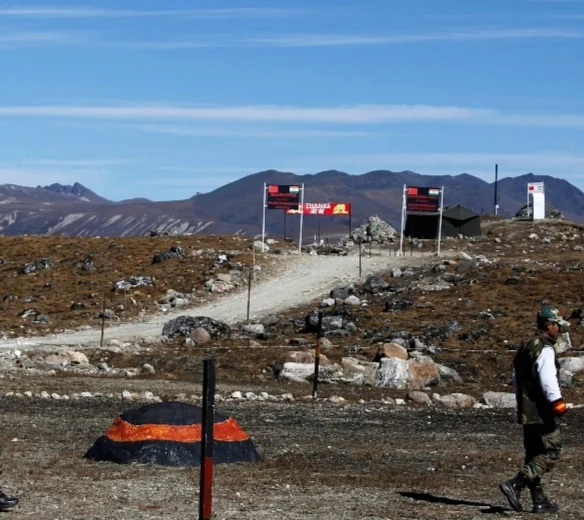
In late July 2026, two patrol parties came face to face in Taksing, a remote border village in Arunachal Pradesh’s Upper Subansiri district. No shots were fired, but the episode has not faded. Chinese troops had reportedly pitched tents near Asaphila, reinforcements were moving up on the Indian side, and on 22 October the Director General of the Indo-Tibetan Border Police told his own personnel that face-offs were still continuing at more than one location.
It is tempting to file this as one more incident on a long list. It is better read as a reminder that the boundary in the east has never been settled, and that the calm that followed the October 2024 disengagement agreement was always thinner than it looked.
The disagreement is simple to state. India holds that Arunachal Pradesh is an integral part of the country. China calls the same land “Zangnan”, or South Tibet, and New Delhi rejects that outright. This is not only a dispute over where patrols may walk but over sovereignty, and it has run for more than six decades, through a war and a string of standoffs.
The trouble starts in 1914. At the Simla Convention, officials of British India, Tibet and China met to settle Tibet’s status, and the talks produced the McMahon Line, named after Sir Henry McMahon, which marked the boundary between British India and Tibet. Tibet’s representatives accepted it. China never ratified the convention and has never treated the line as a legitimate international border.
India inherited the British position at independence in 1947. China saw things differently, especially after the 1949 revolution and its takeover of Tibet in 1950. Then, in 1959, India gave asylum to the Dalai Lama, and what trust remained eroded further.
That August, the first armed clash between independent India and China took place at Longju, in what is now Upper Subansiri district, and it left Indian casualties. After Longju, diplomacy alone was unlikely to settle the boundary.
The war came in October 1962. Chinese forces entered the North-East Frontier Agency, as Arunachal was then called, after heavy fighting around Thagla Ridge and Bum La Pass. Indian positions were poorly prepared and fell quickly. The People’s Liberation Army took Tawang and pushed deep. For India it was a military defeat that left a lasting mark on the national psyche.
Yet China did not stay. After a few weeks it declared a unilateral ceasefire and pulled back from most of the ground it had taken, though it never dropped the claim. What the war left behind was the Line of Actual Control, a de facto boundary that no one ever formally agreed on.
The two countries remember the war very differently, and that gap still matters. India came away convinced that Arunachal is not negotiable. China came away feeling that the eastern sector is unfinished business.
China ties its claim to Tibet. The argument runs that since Tibet was historically Chinese, the areas south of the McMahon Line that Beijing considers culturally Tibetan should be Chinese too. Periodically, Beijing issues its own names for towns, peaks, rivers and passes in the state. The batch in May 2025 covered 27 places, and India’s Ministry of External Affairs called the move “vain and preposterous”, adding that Arunachal would always remain an integral part of India. Beijing was back with another list in April 2026. Renaming changes nothing on the ground, but it keeps the claim alive on official maps and at the negotiating table.
Geography raises the stakes. The state borders Tibet, Bhutan and Myanmar, and its passes link the Indian plains to the Tibetan plateau. Tawang is home to one of the most important Tibetan Buddhist monasteries outside Lhasa, and it lay on the Dalai Lama’s escape route in 1959. That gives it a religious and political sensitivity Beijing cannot ignore.
The practical problem is that the LAC has never been demarcated on the ground, and each side reads it differently. In places the gap is a few hundred metres. Elsewhere it stretches across several kilometres. Patrols walk into areas the other side considers its own, and the result is confrontation and the occasional scuffle.
For years that was manageable. India and China signed agreements in 1993, 1996, 2005, 2012 and 2013 to keep the peace, creating border personnel meetings, hotlines and local consultations. None of them settled who owns what.
Then came 2020. The Galwan Valley clash of 15 June killed 20 Indian soldiers and at least four Chinese soldiers, and ended 45 years without fatal violence on the border. Much of the trust earlier agreements had built disappeared, and the effects were felt along the entire LAC, not just in Ladakh.
The most serious incident in Arunachal before this year took place on 9 December 2022 near Yangtse, in the Tawang sector. India’s account is that Chinese troops tried to change the status quo, Indian soldiers resisted in a physical clash, both sides suffered injuries, and the Chinese were pushed back.
It mattered for three reasons. It came while the Ladakh standoff was still unresolved. It showed that the east could become a new flashpoint while diplomats were busy with Depsang, Demchok and Pangong Tso. And it showed how quickly a local dispute can escalate when there is no agreed boundary. The terrain makes it worse: high ridges, narrow valleys, harsh weather and few roads mean a disagreement over a patrol route or forward post can snowball.
The Taksing episode is the clearest sign yet that the October 2024 agreement, which restored patrolling in Depsang and Demchok and led to disengagement in eastern Ladakh, did not settle the wider border question. That deal covered specific areas in the west. It produced no final settlement and no clarification of the LAC, and it said nothing about China’s claim to Arunachal.
The official picture has been slow to emerge. Reports in July and August described patrol parties meeting in Taksing and Chinese troops later pitching tents near Asaphila, with some accounts putting them several kilometres inside India’s perception of the LAC. The Indian Army did not comment at first. The Ministry of External Affairs said the state of the border would shape the overall relationship, while Beijing described the border situation as generally stable and called Taksing its own “Taxin” in Zangnan.
In September, India and China held two rounds of Corps Commander-level talks in the eastern sector, at the Wacha–Damai meeting point in Upper Subansiri, with a possible Xi Jinping visit to India on the horizon. Then, on 22 October, ITBP chief Shatrujeet Kapur confirmed that the face-offs had not ended. Opposition leaders, including Congress president Mallikarjun Kharge, have demanded that the government explain the situation on the ground. Claims by the state Congress chief that Chinese troops had advanced 40 to 50 kilometres into Indian territory have not been confirmed by officials.
India relies on deterrence, infrastructure and diplomacy together. Over the past decade New
Delhi has sped up road, bridge and tunnel construction and built advanced landing grounds in Arunachal. The Sela Tunnel, on the route to Tawang and inaugurated in 2024, made forward areas easier to reach all year round. In 1962 weak logistics hurt India badly, and better roads help close that gap.
The Army has strengthened its eastern deployment and improved drone and satellite surveillance, while the ITBP has expanded recruitment and infrastructure in the state.
Diplomatically, India says relations cannot return to normal while troops stand face to face along an unsettled border. External Affairs Minister S. Jaishankar has repeatedly described peace and tranquillity on the border as a prerequisite for better ties. That reflects the lesson New Delhi drew from 2020: trade and diplomacy cannot be kept separate from military confrontation.
Five things keep the frontier on edge. First, the claim itself. China has never accepted the McMahon Line, India treats it as the legal boundary, and incidents remain possible as long as that is true. Second, the LAC has no agreed coordinates, so patrols operate in overlapping zones, and every overlap is a chance for a confrontation.
Third, the larger rivalry. India’s closer ties with the United States, Japan, Australia and other Indo-Pacific powers feed Chinese fears of encirclement, while China’s build-up in Tibet, its military modernisation and its assertive posture on the LAC worry India. The border cannot be pulled out of that bigger picture.
Fourth, domestic politics. The Chinese Communist Party presents territorial integrity as a core national interest, and Indian public opinion is firmly against compromise on Arunachal. Leaders in both capitals have little room to give anything away.
Fifth, the military situation since Galwan. Both sides now have more troops, more infrastructure and quicker reactions to any perceived encroachment. That cuts both ways: deterrence is stronger, but forces are closer together and better armed.
Lasting stability needs more than pulling back at individual flashpoints. India and China need a broader framework: clear patrolling rules, better communication between local commanders, safeguards against unilateral changes to the status quo, and in time a clarification of the LAC. The Corps Commander talks in Arunachal indicate at least some recognition of this on both sides.
Politically, it will be hard. China is unlikely to drop its claim to Arunachal, and India will not accept Chinese sovereignty over the state. Demarcating the LAC in the east is difficult for the same reason, since any line drawn on the ground touches the underlying claim. Still, a practical arrangement is possible. It would keep the peace, respect the current pattern of administration, prevent escalation and keep talks going without prejudice to either side’s final position.
Taksing may be resolved quietly, as earlier standoffs were. But the pattern is hard to miss: Longju in 1959, the war in 1962, Yangtse in 2022, and now Taksing, in the same district where the first clash took place. Until India and China build real trust and settle where the line runs, the risk of confrontation will remain.
For the people of Arunachal, none of this is abstract. They live next to one of the most militarised borders in the world, and what is at stake for them is not only roads, schools and hospitals but also their land and identity.
Posted in Diplomacy, Security and Peace

From a line drawn in 1914 to a standoff at Taksing in 2026, the eastern…