Diplomacy
Arunachal’s Restless Frontier: Why the India-China Border Is Heating Up Again
By Sameer Hussain |
From a line drawn in 1914 to a standoff at Taksing in 2026, the eastern…




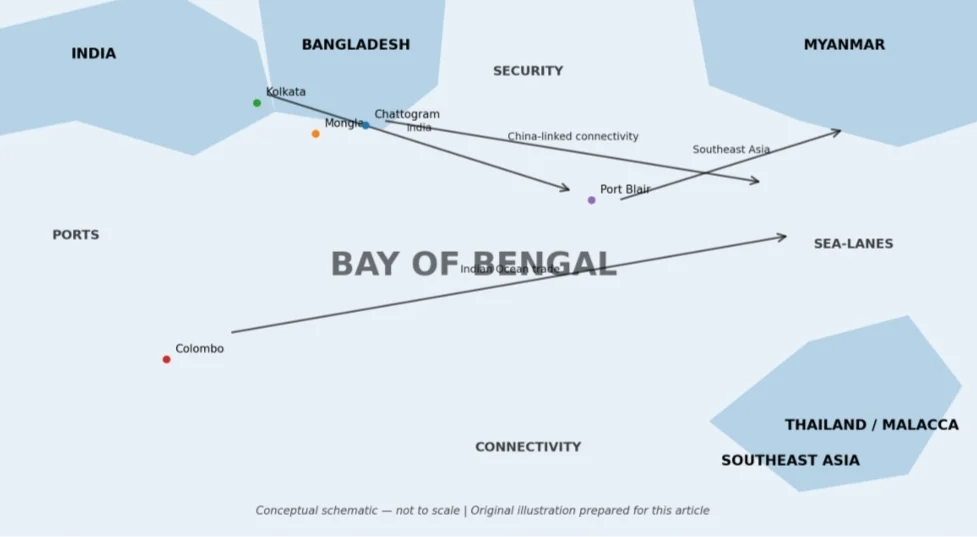
Figure 1. The Bay of Bengal as a strategic crossroads. Original schematic prepared for this article; illustrative and not to scale.
The world’s vital maritime routes do not become strategic solely because of their geographical location. Geography becomes a source of power when economic dependence, military capabilities, and geopolitical rivalries become intertwined within a particular waterway. The Strait of Hormuz and the Bab-el-Mandeb are two significant examples. This raises an important question: is the Bay of Bengal heading towards a similar fate?
The importance of the Strait of Hormuz stems primarily from the geopolitics of energy dependence. In the first half of 2025, approximately 20.9 million barrels of oil and petroleum products were transported daily through the Strait, accounting for roughly one-quarter of globally traded seaborne oil. The global economy’s dependence on this relatively narrow waterway has therefore transformed geography into strategic leverage.
Bab-el-Mandeb offers another lesson: a waterway can be rendered strategically ineffective without being completely closed. Following attacks on commercial vessels beginning in late 2023, shipping was diverted away from the Red Sea route. EIA data show that oil flows through Bab-el-Mandeb fell from 9.3 million barrels per day in 2023 to 4.2 million barrels per day in the first half of 2025. Security risks and higher insurance costs contributed to the wider disruption of maritime trade.
Yet it would be misleading to compare the Bay of Bengal directly with Hormuz or Bab-el-Mandeb. The Bay is not a narrow chokepoint. Its strategic significance lies elsewhere: it is increasingly becoming a strategic crossroads. Situated at the intersection of South Asia, Southeast Asia, and the wider Indo-Pacific, the Bay brings together ports, energy, trade, marine resources, connectivity, environmental risks, and maritime security within one geographic space. Recent analyses describe the Bay as a critical arena where India-China competition, connectivity, and wider Indo-Pacific dynamics intersect.
This is where the distinction between a chokepoint and a fault line becomes important. Hormuz is a chokepoint: geography creates concentrated dependency. The Bay of Bengal is better understood as a potential fault line a region where competing strategic, economic, and political interests are increasingly converging.
For India, the Bay is central to eastern maritime security and connectivity with Southeast Asia. For China, it is an important corridor connecting its wider economic and strategic interests to the Indian Ocean through South and Southeast Asia. The United States, Japan, and other Indo-Pacific powers are also deeply interested in the region’s maritime order. Competition therefore extends beyond warships. It encompasses ports, infrastructure, investment, connectivity corridors, surveillance, maritime domain awareness, and diplomatic partnerships.
This dynamic creates the potential for a classic security dilemma. Port development by one country may be interpreted by another as the creation of strategic infrastructure. Defensive naval activities may similarly be read as signals of expansionism. The overlap between economic infrastructure and security politics makes the Bay’s future particularly complex.
Bangladesh sits at the heart of this transformation. Its maritime connectivity potential is expanding through Chattogram and Mongla, while its location provides a natural bridge between South and Southeast Asia. The strategic rise of the Bay therefore presents Bangladesh with an opportunity to become a more important connectivity hub. Yet the same geography could expose the country to intensifying great-power competition and turn it into a theatre for geopolitical rivalry.
The fundamental question for Dhaka is therefore straightforward: how can Bangladesh derive economic benefits from geopolitical competition without becoming an arena for that competition itself?
The answer lies in strategic autonomy, not strategic isolation.
For Bangladesh, diversified, interest-based relationships with India, China, Japan, the United States, ASEAN, and Europe are likely to be more beneficial than over-reliance on any single power. This does not require Bangladesh to maintain an equidistant position from all actors. Instead, it means preserving strategic space for independent decision-making while pursuing partnerships according to national interests.
BIMSTEC can play an important role. Its maritime-security framework identifies Maritime Domain Awareness, Humanitarian Assistance and Disaster Relief, Oil Pollution Response, Blue Economy, and Maritime Security Cooperation as key areas. BIMSTEC has also been developing guidance for maritime law-enforcement cooperation and exploring stronger information-sharing mechanisms. These initiatives offer Bangladesh a regional platform through which economic connectivity and maritime stability can be pursued together.
This is where Bangladesh could act as a maritime norm entrepreneur: championing freedom of navigation, a UNCLOS-based maritime order, non-coercion, transparency, environmental responsibility, and regional information sharing. UNCLOS provides an important legal foundation, including the right of innocent passage and the broader principle of freedom of navigation under the Convention.
The future of the Bay of Bengal will not be determined merely by the number of warships deployed in its waters. It will also depend on whether regional states can construct a stable, predictable, inclusive, and environmentally responsible maritime order.
Hormuz teaches us how geography can translate into economic leverage. Bab-el-Mandeb demonstrates how insecurity in a strategic waterway can turn a regional crisis into a global trade disruption. The Bay of Bengal presents a third possibility: how great-power rivalry can turn a shared maritime space into a strategic fault line.
Bangladesh’s challenge, therefore, is not to control the Bay of Bengal but to help build a regional maritime order in which no single power can weaponize these waters and geopolitical rivalry does not turn the Bay into another theatre of conflict. The future of the Bay may not ultimately be defined by whether it becomes the next Hormuz. Rather, it will be defined by whether it becomes a sea of rivalry or a sea of cooperation.
Posted in Economy, Politics and Society

From a line drawn in 1914 to a standoff at Taksing in 2026, the eastern…