Diplomacy
Arunachal’s Restless Frontier: Why the India-China Border Is Heating Up Again
By Sameer Hussain |
From a line drawn in 1914 to a standoff at Taksing in 2026, the eastern…




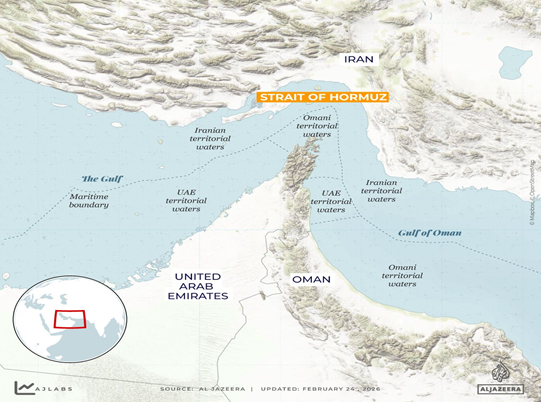
The most important weapon in the Strait of Hormuz may not be a missile, a drone, or a warship. It may be an insurance policy.
For decades, maritime strategy has been built around a simple assumption: whoever wants to control a strategic chokepoint must control the water. Mines, naval vessels, missiles and blockades are therefore treated as the principal instruments through which states can deny access to strategically important sea lanes. The 2026 war involving Iran and the United States-Israel coalition has exposed the limits of that assumption. The Strait of Hormuz did not need to be physically sealed for shipping to collapse. As attacks, security warnings and uncertainty spread, the commercial risk of entering the waterway rose sharply, pushing insurers to reprice war-risk coverage and shipping companies to reconsider whether the voyage was still worth undertaking. The result was a form of maritime coercion that operates without a conventional blockade: the sea remains open, but the market increasingly decides who can afford to cross it.
This matters because the global shipping system is built on a financial infrastructure that is almost invisible until a crisis begins. A tanker cannot simply sail because the waterway remains legally open. It also needs insurance, financing, chartering arrangements and a risk calculation that makes the voyage commercially rational. Once war-risk premiums rise dramatically, the economics of transit change. Reports during the Hormuz crisis indicated that war-risk premiums, which had been around 0.25 percent of vessel value before the escalation, rose into the range of several percentage points, with some July quotations reaching roughly 3–10 percent depending on the vessel and circumstances. For a tanker worth $100 million, that can mean millions of dollars in additional insurance costs for entering a conflict zone. At that point, the decisive question is no longer whether a ship can physically cross the Strait of Hormuz. It is whether its owners, insurers and financiers are willing to pay the price of doing so.
That is what makes insurance a strategic instrument rather than merely a commercial one. A conventional blockade attempts to stop ships through physical force. Insurance-driven denial works through economic calculation. A military attack increases uncertainty; uncertainty becomes actuarial risk; actuarial risk becomes a higher premium; and higher premiums change the behaviour of shipping companies. The waterway does not have to be mined or occupied. It simply becomes too expensive, too uncertain or too commercially dangerous for normal traffic. The distinction is subtle but strategically important: physical access does not necessarily mean economic access.
The phenomenon also exposes a gap in how international relations theory understands weaponised interdependence. Henry Farrell and Abraham Newman showed how states can exploit their advantageous positions within global networks to impose costs on actors dependent upon those networks. Their argument has been particularly influential in explaining financial sanctions, information networks and other infrastructures through which states can turn interdependence into leverage. The Hormuz insurance shock resembles this logic but introduces a crucial complication. The network doing the strategic work is not directly controlled by a single government. London-based insurers, reinsurers, brokers and shipping companies are private actors making commercial decisions under conditions of uncertainty. No foreign ministry needs to order them to restrict trade. The market can produce the coercive effect by itself.
This creates a new and uncomfortable question for international security: what happens when a network becomes strategically coercive without being deliberately weaponised by a state?
Iran does not need to instruct insurers to increase premiums. Nor does the United States or Israel need to instruct every shipowner to avoid Hormuz. Once the perceived probability of attack rises, private actors respond to their own exposure to loss. Yet their decisions can collectively produce consequences that are unmistakably geopolitical. This is better understood as market-mediated coercion: military insecurity is translated into financial risk, financial risk into commercial behaviour, and commercial behaviour into strategic disruption.
The Red Sea crisis offered an earlier demonstration of this mechanism. Houthi attacks on commercial shipping did not need to destroy a large proportion of vessels in order to alter the behaviour of global shipping companies. The possibility of further attacks was enough to change risk calculations, insurance costs and routing decisions. The economic effect consequently became much larger than the direct physical damage. Hormuz has demonstrated the same principle at a much greater strategic scale because of the importance of the waterway to global energy markets.
The significance of this mechanism lies precisely in its amplification effect. A missile striking one tanker directly affects one vessel. An insurance market reassessing the risk of an entire region can affect hundreds of future voyages. The market therefore transforms a localised security incident into a system-wide economic signal. Insurers are not simply calculating what has already happened; they are pricing what might happen next. Under conditions of limited information and potentially catastrophic losses, conservative risk assessment is rational. But the aggregate result can be politically destabilising.
This creates a dilemma for traditional deterrence. Governments can deploy naval forces to protect shipping, but they cannot easily command private insurers to accept unlimited exposure. A naval escort may make one voyage safer without convincing the market that hundreds of future voyages are safe. In other words, governments may be able to protect a ship without being able to restore the market’s confidence in the route.
That is where the strategic significance of the insurance market becomes clearer. Maritime power is no longer confined to warships, submarines, aircraft and missiles. It also exists in the less visible infrastructures that allow commercial vessels to move: insurance, reinsurance, finance, chartering, port access and risk assessment. These institutions do not possess military power, but they can determine whether military protection translates into actual commercial movement.
The policy implications are therefore significant. Governments concerned about the resilience of strategic waterways should stop treating insurance as a secondary commercial matter and start treating it as part of maritime security. Additional naval deployments may reduce physical risks, but they do not necessarily solve the financial problem created by extreme uncertainty. If private insurance capacity retreats from a strategic chokepoint, governments and international institutions may need mechanisms capable of stabilising the market.
There is historical precedent for such intervention. During the Second World War, governments stepped in when private marine insurance capacity proved inadequate to sustain wartime trade. A modern version could involve a multilateral reinsurance facility backed by states whose economies depend heavily on the continued operation of major maritime chokepoints. Such a mechanism would not eliminate risk or encourage reckless shipping. Its purpose would be to prevent temporary geopolitical shocks from turning into prolonged commercial paralysis.
The International Maritime Organization and other multilateral institutions could also contribute by strengthening information-sharing and developing more transparent frameworks for assessing maritime risk. The objective should be to reduce the information uncertainty that encourages insurers to price extreme scenarios into every voyage. The less reliable the information environment, the more aggressively private markets will tend to protect themselves against catastrophic loss.
The broader lesson extends beyond Hormuz. The Red Sea and Bab el-Mandeb have already shown how insecurity can reshape global shipping through commercial risk calculations. Similar dynamics could emerge in other contested maritime spaces, including the South China Sea and other strategic trade corridors. In each case, the question will not simply be whether a state possesses the military capability to disrupt shipping. It will also be whether that actor can create enough uncertainty for private markets to amplify the disruption.
This changes the geography of maritime coercion. In the past, controlling a chokepoint meant controlling the water. Increasingly, it may also mean influencing the risk environment surrounding the water. A state or non-state actor does not necessarily need to maintain a permanent blockade if a limited number of attacks can persuade insurers that the probability of future losses has become unacceptable. The market then performs part of the coercive function.
This does not mean that insurers have suddenly become geopolitical actors in the traditional sense. Their primary responsibility remains commercial risk management. That is precisely why the phenomenon is so important. Strategic consequences can emerge from decisions that are not themselves strategic. An underwriter may simply be protecting capital. A shipowner may simply be protecting its vessel. A bank may simply be protecting its financing. Yet together, these decisions can produce an effect comparable to a blockade.
The Strait of Hormuz therefore reveals a new vulnerability in the global maritime order. States have spent decades building naval capabilities to protect strategic waterways, but comparatively less attention has been paid to the private financial infrastructure that determines whether commercial vessels are willing to use those waterways. The next maritime crisis may therefore not be decided only by who controls the sea, but by who controls the conditions under which the market considers the sea insurable.
The real strategic weapon may consequently be neither the missile nor the warship. It may be the price attached to the risk of sailing.
A chokepoint can be closed by force. It can also be closed by fear. And when fear is converted into an insurance premium, a private market can become an unexpected instrument of geopolitical coercion.
Posted in Security and Peace

From a line drawn in 1914 to a standoff at Taksing in 2026, the eastern…