Diplomacy
Arunachal’s Restless Frontier: Why the India-China Border Is Heating Up Again
By Sameer Hussain |
From a line drawn in 1914 to a standoff at Taksing in 2026, the eastern…




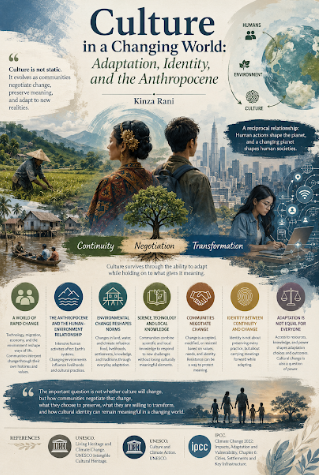
Culture Is Not Static
Culture is often understood through the traditions, values, norms, beliefs, and practices that connect people with their communities and their histories. Yet culture is not a static phenomenon. It changes gradually and steadily as communities encounter new social, environmental, technological, and historical circumstances.
Cultural change does not necessarily mean the loss of cultural identity. Communities can modify particular practices while preserving values, memories, symbols, and relationships that remain important to them. Culture can therefore maintain continuity while changing its form.
Adaptation is an important part of this process. Communities do not simply accept every change that reaches them. They negotiate change according to their existing values and circumstances. Some changes are accepted, some are modified, and others are resisted. Through this ongoing process, culture continues to evolve.
A World of Rapid Change
Contemporary communities are experiencing multiple and interconnected forms of change. Technological advancement, expanding social connections, migration, economic transformation, and environmental disruption increasingly influence local cultures.
Technology can change communication, employment, education, and patterns of social interaction. Migration brings people into contact with different languages, foods, values, and ways of life. Environmental changes can affect livelihoods and everyday routines.
However, these influences do not simply replace existing cultures. Communities interpret them through their own histories and cultural frameworks. A new practice may be incorporated into an existing tradition, while another may be rejected because it conflicts with deeply held values.
Cultural change is therefore not simply a movement from an “old” culture to a “new” one. It is a process of negotiation.
The Anthropocene and the Human–Environment Relationship
The Anthropocene provides an important perspective for understanding this relationship because human activities have become a significant force affecting the Earth’s systems. Intensive resource use, deforestation, pollution, and changes to landscapes and water systems can contribute to environmental transformation.
At the same time, people experience the consequences of these environmental changes. Extreme rainfall, flooding, changing agricultural conditions, water shortages, and other environmental pressures can disrupt established ways of living.
The relationship is therefore reciprocal. Humans influence their environments, while changing environments influence human societies and their cultural practices.
Culture does not exist separately from the environment. The ways communities use land, water, forests, and other resources are shaped by cultural values, while environmental changes can require communities to reconsider how those resources are used.
When Environmental Change Reshapes Cultural Norms
Environmental change does not automatically transform culture. Instead, it changes the conditions under which cultural practices take place.
For example, when agricultural conditions change, communities may need to modify planting seasons, crops, water-use practices, or livelihood strategies. Such changes can gradually influence food traditions, household responsibilities, seasonal activities, and knowledge passed between generations.
Flooding can also require changes in settlement practices, housing, mobility, and ways of protecting resources. Water scarcity may encourage new systems of sharing and managing water.
The change therefore occurs through everyday adaptation. When a community repeatedly adjusts its practices to respond to new circumstances, those adjustments can eventually become part of its cultural life.
UNESCO similarly recognizes that climate change can affect living heritage while cultural knowledge and practices can also contribute to community resilience and adaptation.
Science, Technology, and Local Knowledge
Scientific and technological advancement provides another pathway through which cultural practices can change. New technologies can transform how communities cultivate land, obtain water, harvest resources, communicate, and organize their livelihoods.
Yet technological advancement does not necessarily mean the disappearance of local knowledge. Communities may combine scientific knowledge with traditional and local knowledge to respond to new circumstances.
This combination is significant because adaptation does not always require choosing between “traditional” and “modern.” Communities can reshape existing knowledge and incorporate new approaches while retaining culturally meaningful elements.
UNESCO has highlighted the importance of traditional and local knowledge in climate adaptation, including knowledge related to food security, water management, and relationships with the environment.
Communities Negotiate Change
Communities are not passive recipients of environmental, technological, or social change. They actively negotiate it.
Some changes may be accepted because they provide practical solutions to new problems. Others may be modified so that they fit established cultural values. Some may be resisted because they are perceived as threatening important traditions or collective identity.
Resistance, therefore, should not automatically be understood as opposition to progress. It can represent an attempt to protect meanings and values that a community considers important.
At the same time, resistance does not necessarily prevent cultural transformation. A practice that is initially resisted may later be modified and incorporated in a different form. Cultural change can therefore involve both continuity and negotiation.
Identity Between Continuity and Change
The question of cultural identity is central to adaptation. If culture changes, does identity disappear?
Not necessarily.
A cultural practice can change in its form while retaining its underlying meaning. A community may modify a tradition because environmental conditions have changed while preserving the values associated with that tradition. New technology may alter how people communicate without necessarily eliminating their sense of belonging.
Cultural identity is therefore not dependent upon keeping every practice exactly as it was in the past. It can also be expressed through the ability to carry meaningful values forward while responding to present circumstances.
The IPCC has similarly noted that cultural heritage is closely connected with identity, history, memory, and livelihoods, while climate change can place both tangible and intangible cultural practices under pressure.
Adaptation Is Not Equal for Everyone
The ability to adapt is not distributed equally. Communities differ in access to economic resources, technology, education, political influence, and environmental security.
For some communities, adaptation may involve choosing among several possible responses. For others, environmental disruption may leave very few alternatives. People may have to change their livelihoods or practices not because they freely choose to do so, but because changing circumstances make previous ways of living increasingly difficult.
This makes cultural adaptation more than a question of cultural flexibility. It is also a question of power.
Who decides what should change? Whose knowledge is considered valuable? Who benefits from new technologies or environmental policies? And who carries the costs of adaptation?
These questions are essential if cultural change is to be understood beyond a simple idea of progress.
Adaptation as Cultural Continuity
Culture survives not because it remains unchanged, but because communities continually negotiate what should be retained, modified, or allowed to change.
Adaptation can therefore become a mechanism of cultural continuity. Communities may reshape their practices while maintaining the values and meanings that give those practices significance.
The challenge is not to prevent cultural change altogether. Rather, it is to understand how communities themselves participate in shaping change and how their cultural knowledge and identities can remain meaningful within new environmental and social realities.
Conclusion: Between Continuity and Transformation
Culture has always changed. What makes the present moment particularly significant is the speed and scale of technological, environmental, and social transformation.
The Anthropocene highlights the reciprocal relationship between human activity and environmental change. Human actions can transform environments, while those transformations can influence livelihoods, social practices, norms, and cultural responses.
Communities respond to these pressures in different ways. They may accept some changes, resist others, and reshape still others. Their responses are influenced by cultural values, local knowledge, generational differences, migration, technology, available resources, and unequal power.
The important question, therefore, is not whether culture will change. It is how communities negotiate that change, what they choose to preserve, what they are willing to transform, and how cultural identity can remain meaningful in a changing world.
References
UNESCO. Living Heritage and Climate Change. UNESCO Intangible Cultural Heritage.
UNESCO. Culture and Climate Action. UNESCO.
IPCC. Climate Change 2022: Impacts, Adaptation and Vulnerability, Chapter 6: Cities, Settlements and Key Infrastructure.
Posted in Anthropocene, Religion and Culture

From a line drawn in 1914 to a standoff at Taksing in 2026, the eastern…