Diplomacy
Arunachal’s Restless Frontier: Why the India-China Border Is Heating Up Again
By Sameer Hussain |
From a line drawn in 1914 to a standoff at Taksing in 2026, the eastern…




Background
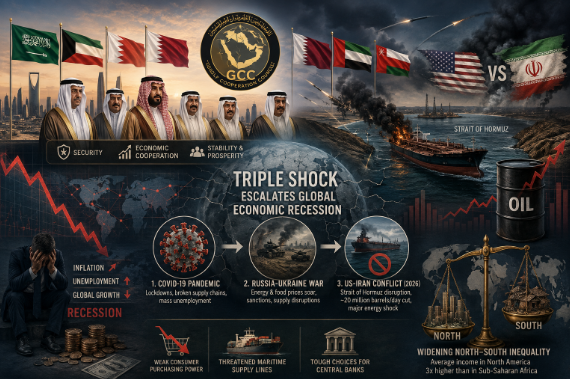
On May 25, 1981, in Riyadh, Saudi Arabia, a regional alliance was formed, the Gulf Cooperation Council (GCC), consisting of six Gulf monarchies Saudi Arabia, Kuwait, Bahrain, Qatar, the United Arab Emirates and Oman. The region’s troubled environment, created by the Iran-Iraq war and the Revolution in Iran in 1979, was a major driver in its creation, as it increased security concerns for the Gulf states[i]. Political systems, cultural traditions and economic dependence on oil were common and collaboration was possible and essential. The GCC Charter focused on the political, economic, social and cultural aspects of coordination, integration and interconnection. Security was the primary concern, but another was economic cooperation, manifesting itself in several projects: the Unified Economic Agreement (1981) and the Gulf Investment Corporation (1983). The Peninsula Shield Force was established in 1984 by the members of the Gulf Cooperation Council (GCC) as a military alliance to protect the member states from external threats. The GCC eventually emerged as an important geopolitical group and has been a powerful force during the Persian Gulf War of 1990–91 and throughout the Middle East political landscape, especially in regard to the power struggle between the GCC and Iran or any other regional conflict.
The geopolitical importance of the Gulf Cooperation Council (GCC) and US-Iran Conflict
The Gulf Cooperation Council (GCC) has become a vital geopolitical institution in recent times due to the crises in the region, both as a security body and as a mediator in the region’s affairs[ii]. The Gulf Cooperation Council (GCC) countries of Bahrain, Kuwait, Oman, Qatar, Saudi Arabia and the UAE have managed the Yemen crisis, the diplomatic conflict with Iran and the 2017 crisis between the Gulf and Qatar, all the while trying to keep their collective house in order. The region’s strategic position, at the heart of the Strait of Hormuz, where one-fifth of the world’s oil travels, further reinforces its importance for global energy security and great-power rivalry. GCC countries have been adopting hedging policies as well, forming more dynamic ties outside the traditional U.S.-centered coalition, with a focus on Russia and China in recent years, to seek strategic autonomy.[iii] The council has also served as a mediator in conflicts; Qatar held negotiations with the U.S. and the Taliban, and Saudi Arabia mediated regional negotiations. The GCC is a key player in the security dynamics of the Middle East, which is subject to multiple competing forces from Iran, Israel and outside actors; it is also striving to diversify its economy via national visions despite its divisions. Its value in adapting to multipole dynamics is a testament to its long-term relevance in an unstable area.
Triple Shock escalates the global economic recession
In the early 2020s, the world economy experienced what was ultimately a ‘triple shock’ – a series of crises that brought unprecedented and lasting recessionary pressures to the world economy. The COVID-19 pandemic was the first catastrophe and it has come with an unprecedented shock, bringing down the global GDP by more than three percent through synchronized lockdowns, broken supply chains, and mass unemployment, since the Great Depression[iv]. When economies were slowly recovering, Russia’s full-scale invasion of Ukraine in 2022 triggered fresh disruptions, pushing energy and food prices to record levels, adding to inflationary pressures and disrupting energy and food supply chains with sanctions and supply constraints.[v] The war between the United States and Iran that followed added to these weaknesses in 2026, effectively shutting down the Strait of Hormuz, cutting off about twenty million barrels of daily crude supply and causing major energy supply disruptions that plunged already fragile economies into full recession[vi]. In combination, these overlapping crises diminished consumer purchasing power, threatened vital maritime supply lines and compelled central bankers to make tough choices between fighting inflation and keeping growth going. The net result was a long global recession that revealed the interdependency of today’s economies and the devastating economic impacts of simultaneous geopolitical and increased the gap between rich and poor. The triple shock has also widened the North-South inequality with average incomes in North America being three times as high as the average in the global South, and the low income countries in the Global South lack the fiscal resources to provide sufficient social protection measures, as COVID-19 alone pushed an estimated 93 million people into extreme poverty in 2020.[vii] Worldwide, these overlapping crises are halting years of progress, with the combined effect of the Covid-19 pandemic, war and energy shocks likely to push another 75-95 million people back into extreme poverty in 2022 alone, undoing over four years of poverty reduction gains.[viii]
Saudi Arabia’s Evolving Role in the GCC and Yemen’s crises
Saudi Arabia always played a dominant role in the Gulf Cooperation Council (GCC) due to its large oil reserves, military strength, and economic significance, and has influenced the security agenda and institutional direction of the organization.[ix] Riyadh has traditionally asserted its power through the economy and the military, and is currently the most vocal backer of the GCC coalition against Yemen’s Houthis since 2015, which has sought to curb Iranian influence on its southern border, while also being the biggest contributor to the region’s defense spending and GDP.[x] But in recent years, Saudi Arabia has turned toward active diplomacy to pull itself out of the expensive Yemen war and away from the potential regional chaos. This shift resulted in face-to-face discussions with the Houthis in 2023, including a historic Saudi Arabia’s Ambassador Mohammed al-Jaber’s visit to Sana’a, and the reciprocal talks between the Saudi and Houthis in Riyadh, which focused on a comprehensive ceasefire, payment of salaries to public sector employees, and the reopening of major ports and airports.[xi] Riyadh’s focus on de-escalation, rather than confrontation, and its unprecedented direct engagement with the Houthis, reflects its pragmatic shift in regional policy, acknowledging the need to avoid a regional war in Yemen while maintaining its traditional leadership in the region.
The GCC’s De-escalation Role and the Global Economic Crises
The Gulf Cooperation Council (GCC) has increasingly been playing a key role in keeping the region out of regional wars by engaging in diplomacy and collective security measures.[xii] The GCC countries have tried to defuse tension, whether by Omani mediation between Tehran and Washington or by Saudi involvement in Iran or by successfully resolving the 2017-2021 Gulf Crisis, in order to protect their own ambitious economic visions from the threat of wider war.[xiii] The strategic shift is part of a pragmatic decision to understand that collective security and regional stability are key to addressing external threats – though, in his past, the council has witnessed member states pursue self-interest rather than cooperate in major disputes. The council’s adaptive policies are an indicator of the council’s awareness of a full-scale war would threaten their energy supplies, shipping routes and trade. If the war between the U.S. and Iran does escalate, however, the world’s economy would suffer catastrophic consequences, as simulations illustrate that a war between the two countries would cause significant price volatility in oil and global energy markets. About one-fifth of the world’s petroleum and a high percentage of LNG passes through the Strait of Hormuz and if it were cut, it would have repercussions on world supply chains, food security and inflation.[xiv] Producers of everything from food to goods would be under severe cost pressure, and any emerging markets that rely on energy from the Gulf would be in a position of balance-of-payments crisis and currency instability. The cost of maritime shipping insurance would increase dramatically, rerouting would cost more and more food would be lost – food is vital for people around the world. Therefore, the mediation efforts of the GCC not only benefit regional interests, but also the economic stability of the world as the other scenario, of a wider conflict that might endanger Hormuz, would have systemic repercussions that would reach far beyond the Middle East, highlighting the council’s critical role in averting a geopolitical and economic catastrophe.
Recommendations to GCC
[i] Subanthore, A. (2021). Saudi arabia establishes gulf cooperation council. EBSCO. https://www.ebsco.com
[ii] Koch, C. (2020). The evolution of the regional security complex in the mena region. In V. Gervais & S. Van Genugten (Eds.), Stabilising the Contemporary Middle East and North Africa (pp. 19–39). Springer International Publishing. https://doi.org/10.1007/978-3-030-25229-8_2
[iii] Raǧab, Ī. A., & Colombo, S. (Eds.). (2018). Foreign relations of the GCC countries: Shifting global and regional dynamics. Routledge.
[iv] Tooze, J. A. (2021). Shutdown: How COVID shook the world’s economy (International edition, export edition). Viking.
[v] Tyagi, K. (2024). The impact of russia – ukraine war on global economy. International Journal For Multidisciplinary Research, 6(5), 29797. https://doi.org/10.36948/ijfmr.2024.v06i05.29797
[vi] Ruiz Estrada, M. A., Park, D., Tahir, M., & Khan, A. (2020). Simulations of US-Iran war and its impact on global oil price behavior. Borsa Istanbul Review, 20(1), 1–12. https://doi.org/10.1016/j.bir.2019.11.002
[vii] Chancel, L., Piketty, T., Saez, E., & Zucman, G. (2022). The World InequalityReport 2022. World Inequality Lab. https://wir2022.wid.world/
[viii] United Nations Department of Economic and Social Affairs. (2022). The sustainable development goals report 2022. United Nations.
[ix] Arafat, A. A.-D. (2020). Regional and international powers in the gulf security (1st ed. 2020). Springer International Publishing.
[x] Juneau, T. (2024). Saudi Arabia’s costly war in Yemen: A neoclassical realist theory of overbalancing. International Relations, 00471178241231728. https://doi.org/10.1177/00471178241231728
[xi] Alsudani, A. F. (2024). Yemen at the crossroads: The houthis, iran, and saudi arabia under the spotlight. London School of Economics Undergraduate Political Review, 8(1), 48–56.
[xii] Bakir, A., Ulrichsen, K. C., & Cafiero, G. (Eds.). (2026). The gulf cooperation council (Gcc) states amid the iran–israel rivalry: Foreign Policy, Security, and the New Geopolitics of the Gulf. Palgrave Macmillan.
[xiii] Abdelkhalek, A. A. E. (2022). The role of gulf cooperation council in conflict management, 1981–2019: A comparative study. Contemporary Review of the Middle East, 9(1), 99–115. https://doi.org/10.1177/23477989211057341
[xiv] Wen, Z. (2024). Impact of political changes in middle eastern energy on global energy security. In Z. Zhan, J. Liu, D. M. Elshenawi, & E. Duester (Eds.), Proceedings of the 2024 10th International Conference on Humanities and Social Science Research (ICHSSR 2024) (Vol. 858, pp. 454–461). Atlantis Press SARL. https://doi.org/10.2991/978-2-38476-277-4_51
short author bio
Dr. Muhammad Atif is the Head of Department and Assistant Professor in the School of Integrated Social Sciences at The University of Lahore (Sargodha campus), Pakistan. His research interests encompass Regional Organization, International Development, International Political Economy, Global Governance and International Organization.
Posted in Economy, Security and Peace

From a line drawn in 1914 to a standoff at Taksing in 2026, the eastern…