Diplomacy
Arunachal’s Restless Frontier: Why the India-China Border Is Heating Up Again
By Sameer Hussain |
From a line drawn in 1914 to a standoff at Taksing in 2026, the eastern…




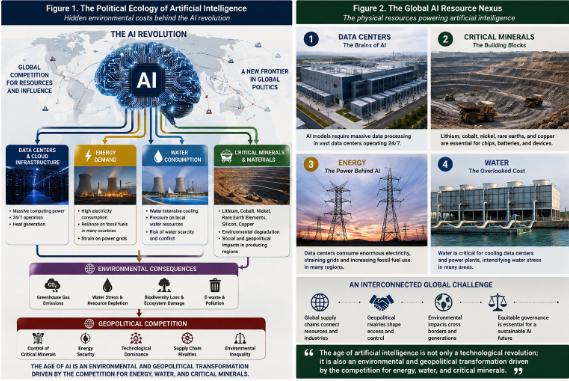
“The age of artificial intelligence is not only a technological revolution; it is also an environmental and geopolitical transformation driven by the competition for energy, water, and critical minerals.”
Ask most people what AI costs and they’ll think in dollars subscription fees, chip prices, maybe a company’s stock price. Few think about rivers. Fewer still think about mines.
Artificial intelligence is often viewed commonly as a contest over algorithms, advanced chips and digital innovations. Rarely it is discussed as a contest over rivers , electrical grids and mineral reservoirs. Yet that is precisely what it has transformed into. Every significant AI framework that a government or company develops today relies on three resources that nations have fought wars over in the past: energy, water and critical minerals. As countries compete to dominate in artificial intelligence, the environmental burden behind that competition has evolved into a significant concern of international relations, one that involves energy security, resource diplomacy and the balance of power between the nations that host AI infrastructures and nations that lack such infrastructure.
Electricity as a Strategic Resource:
Energy has steadily emerged as one of the major battlefield of the AI Rivalry .The International Energy Agency reports that power consumption by Data Centres rose 17% globally in 2025 while power consumption particularly for AI technologies rose by 50%, which is much higher than the 3 percent increase in global power demand as a whole. The IEAs Satellite monitoring indicates that data centres built entirely for AI have expanded three times in capability in just 1.5 year duration, a pace that is now transforming the national energy strategy in the United States, China ,India and the Gulf a like.
This is not a temporary spike; it is a systematic transformation with strategic significance. The IEA estimates that entire power demand from data centres will approximately twice by 2030, with the AI-specific share thrice in that time. Even through the agency describes efficiency gains per AI as increasing “at a rate which was exceptional in energy history,” the immense scale of worldwide AI implementation is surpassing those gains. For states, this means energy capability itself is emerging as a form of strategic advantage, an asset that decides which countries can host advanced AI infrastructure and which cannot.
The Department of Energy’s Lawrence Berkeley National Laboratory (LBNL) estimated that data centres in the U.S. could consume up to 11.8 percent of the nation’s electricity consumption by 2030, a substantial increase from less than 5 percent a decade ago. . That one forecast alone has already changed the way American utilities plan grid investments, and it’s a good example of how a technology race in another country can subtly alter energy policy at home.
The amount of investment behind this is itself a geopolitical signal. The IEA indicates that capital investment in data centre construction by the biggest tech firms has exceeded 400 billion dollars in 2025 and is expected to increase by 75 percent in 2026, which is enough to influence where countries choose to setup new power plants and grid connections and therefore where global AI capacity will physically be located.
The global allocation of data-facilities electricity demands are highly uneven, illustrating wider strategic imbalances. As reported by the International Energy Agency (IEA) global data centres consumed nearly 415 terawatt/hours (TWh) of electricity in 2024, with the United States accounting for 45 percent followed by China at 25 percent and Europe at 15 percent. Because so few countries host the bulk of this infrastructure, control over AI compute is concentrated in the hands of a small number of states, a pattern with echoes of earlier resource-based hierarchies in the international system, only this time the resource is processing power rather than oil or minerals alone.
Water and the Politics of Scarcity:
Water adds another more critical dimension of the AI infrastructure, as water security is already a cause of tension between states and communities. An official review conducted for the United Kingdom government determined that national water resource plan, including some approved recently in 2025, haven’t sufficiently accounted for the rising water requirements associated with AI data centres. The report warns that this omission might impose further burden on previously constrained water resources in a country that is estimated to confront a daily water shortage of several billion litres by the mid-century.
The same story is true on a global scale in the corporate disclosures. Google’s 2026 Environmental Report reveals that in 2025, Google used 10.9 billion gallons of water, which is a 34 percent increase from the previous year and more than double the amount used in 2021. Google has replaced about 7.7 billion gallons, or 78 percent, of water that it removed, through 165 water projects across 97 watersheds worldwide. In essence, tech firms are now running their own water diplomacy, one river basin at a time.
This United Nations has determined cannot be left to companies alone. A study by the United Nations University’s Institute for Water, Environment and Health (IWEH) in June 2026 highlighted the potential of AI infrastructure to impose a heavy burden on the world’s freshwater resources within a decade, urging UN Secretary-General António Guterres to call for “no more hidden costs” in the accounting of AI companies’ environmental impact.
Emissions, Reputation and Soft Power
Every AI chip starts life as ore in the ground and that ore is dominated by a small number of nations, which makes it a significant strategic move rather than a simple commerce. The IEA’s Global Critical Minerals Outlook found prices for germanium, gallium, silicon, cobalt and rare earth minerals increased rapidly through 2025 and into 2026 as required from AI equipment, electronics and robotics expansion. It has added extra burden on minerals excavation zones which are already dealing with water shortage and ecological harm from excavation.
The hardware doesn’t last long, eliminating it has become a concern all its own. The International Telecommunication Union (ITU) and the United Nations Institute for Training and Research (UNITRAC) jointly produced the Global E-waste Monitor, which found that electronic waste (e-waste) amounted to 62 million tonnes globally in 2022, representing an increase of 82 per cent from the 2010 figure, and only around 22 per cent was collected and recycled properly. Recycling only supplies 1 percent of global demand for rare earth metals, the report said, leaving almost all AI’s mineral supply chain reliant on new extraction instead of reuse.
Semiconductor fabrication and Taiwan’s Strategic Exposure:
A water footprint is left on a chip before it even arrives at a data centre, and a political one too. The process of chip making demands a massive amount of ultra-pure water for cleaning silicon wafers, and this step in the process is concentrated almost entirely in one place: Taiwan, home to TSMC. Which make most of the world’s most advanced chips. TSMC’s own 2024 Sustainability Report indicates that the company now recycles over 90 percent of its water at multiple facilities, and is developing additional reclamation plants in Taiwan and Arizona but the same report also acknowledges that its growing factories still consume large amounts of fresh water in an area that has suffered from repeated, severe droughts over the past decade.
This concentration makes Taiwan’s water source a matter of global strategic issue rather than just a local one. Indeed, so much of the world’s sophisticated computing power relies on chips produced on one small, water-stressed island that if it suffers a drought or a supply disruption, the impact would ripple far beyond its borders, adding to the tensions between the mainland and Taiwan in the island’s security politics. So, the environmental narrative of AI doesn’t start at the data centre. It starts several steps back, in the fabs that make the chips those data centres are run on.
A Governance Gap in the Global Politics:
Electricity, water, carbon and minerals have always been dealt with individually: energy ministries dealt with electricity, water ministries with rivers, environment ministries with emissions and trade ministries handle minerals. AI infrastructure spans all four at once and the world’s institutions have been slow to catch up. The new transparency initiative by the United Nation is one of the first coordinated efforts, but it is still voluntary and not yet any such coordinated effort exists in trade or energy diplomacy.
There is a fairness concern lies in this gap too, and it is one that is reminiscent of past arguments over oil. Because data centres capacity clusters in the United States, China and Europe. The environmental cost of AI, the water it consumes, the emissions it produces, the minerals it extracted, falls disproportionately on a handful of places, while the profits and strategic control of the technology are concentrated in those same countries. Even when the minerals that fuel AI hardware are mined within their borders, states with limited data-centre capacity have virtually no control over how these trade-offs are managed. Addressing this imbalance, rather than leaving AI governance solely in the hands of the world’s largest economies, is likely to become one of the key diplomatic challenges of the coming decade.
Summary:
“The future of AI will be shaped not only by advances in algorithms, but also by the ability to govern the environmental and strategic resources on which intelligence depends.”
The environmental impact of Artificial intelligence is not just a side note to the technology dominance desire; it’s one of the key elements at the heart of it. Electricity determines which nation will be able to accommodate frontier AI systems. Data centre siting is becoming a diplomatic hot potato between businesses, communities and governments as water becomes a scarce resource. Carbon accounting is putting the climate pledges to the test. And, mineral supply chains are tying up AI hardware with the same resource politics that has governed relations between mineral-rich and mineral-poor states for generations. Rivers, grids and mines, in addition to models and chips, are part of any serious discussion on the future of AI.
None of this is an excuse to not invest in AI infrastructure, and the official record doesn’t indicate that governments or companies are simply ignoring the concern. What it does indicate is that AI’s environmental footprint can’t just rest on the desks of engineers and sustainability departments. It has turned into a matter of foreign policy, an energy policy, a resource diplomacy which will define the inter-state relations like oil, water rights, rare minerals for decades. The countries and companies that catch on early and begin to incorporate energy, water, and mineral resilience into their AI strategies now will find themselves far better placed than those still treating the physical world as an afterthought to a digital revolution
References:
Executive summary – Key Questions on Energy and AI – Analysis. (n.d.). IEA. Retrieved July 31, 2026, from https://www.iea.org/reports/key-questions-on-energy-and-ai/executive-summary
Executive summary – Electricity 2026 – Analysis. (n.d.). IEA. Retrieved July 31, 2026, from https://www.iea.org/reports/electricity-2026/executive-summary
United States Data Center Energy Usage Report: 2025 Update | Energy Technologies Area. (n.d.). Retrieved July 31, 2026, from https://eta.lbl.gov/publications/united-states-data-center-energy-2025
Water_use_in_data_centre_and_AI_report.pdf
Weaponized Interdependence: How Global Economic Networks Shape State Coercion | International Security | MIT Press. (n.d.). Retrieved April 3, 2026, from https://direct.mit.edu/isec/article/44/1/42/12237/Weaponized-Interdependence-How-Global-Economic
say, H. your. (2026, July 29). Empowering data center sustainability in the UK’s AI-driven future. https://www.datacenterdynamics.com/en/opinions/empowering-data-center-sustainability-in-the-uks-ai-driven-future/
2026 Environmental Report. (n.d.). Sustainability. Retrieved July 31, 2026, from https://sustainability.google/reports/google-2026-environmental-report/
Smith, B. (2026, July 9). Responsibly building the AI future. Microsoft On the Issues. https://blogs.microsoft.com/on-the-issues/2026/07/09/responsibly-building-the-ai-future/
Global Critical Minerals Outlook 2026 – Analysis. (2026, July 16). IEA. https://www.iea.org/reports/global-critical-minerals-outlook-2026
Global e-Waste Monitor 2024: Electronic Waste Rising Five Times Faster than Documented E-waste Recycling | UNITAR. (n.d.). Retrieved July 31, 2026, from https://unitar.org/about/news-stories/press/global-e-waste-monitor-2024-electronic-waste-rising-five-times-faster-documented-e-waste-recycling
TSMC 2024 Sustainability Report
Asadullah, M. (2026). UN Secretary-General launches AI Environmental Transparency Initiative, calling on AI companies to disclose carbon, water and land footprints. https://unu.edu/inweh/news/un-secretary-general-launches-ai-environmental-transparency-initiative-calling-ai
Posted in Politics and Society, Science and Technology

From a line drawn in 1914 to a standoff at Taksing in 2026, the eastern…