Diplomacy
Arunachal’s Restless Frontier: Why the India-China Border Is Heating Up Again
By Sameer Hussain |
From a line drawn in 1914 to a standoff at Taksing in 2026, the eastern…




Three New Zeros: Unintended Legacy of the Yunus-Government
Political and International Affairs Analyst
When Bangladesh’s interim government assumed office in August 2024, it inherited a country in crisis.
The political system had collapsed into uncertainty. Confidence in state institutions was low. The banking sector was burdened by years of mismanagement and allegations of politically connected lending. Foreign exchange reserves were under pressure, inflation remained painful for ordinary citizens, and many feared a deeper economic shock.
In that environment, the interim administration led by Nobel Laureate Dr. Muhammad Yunus deserves recognition for several important achievements. The government moved quickly to restore confidence in the financial sector, engage with international development partners, and stabilize key macroeconomic indicators. Banking reforms, efforts to recover institutional credibility, and renewed engagement with foreign stakeholders helped prevent what many feared could become a severe economic crisis. Bangladesh avoided the kind of economic breakdown that some observers had predicted during the turbulent months following the political transition.
These accomplishments should be acknowledged.
Yet economic stabilization alone cannot sustain public trust. A government that came to power promising transparency, moral authority, and a clean break from old political habits must also be judged by how accountable it remained to the citizens in whose name it governed.
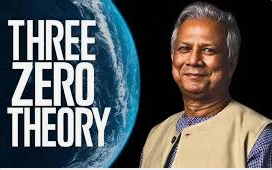
If Dr. Yunus once challenged the world to imagine a future defined by three zeros, Bangladesh may ultimately remember another kind of zero that emerged during the interim period.
The first of those zeros is Zero Accountability.
Dr. Yunus and his group of advisers entered public office carrying a level of moral authority rarely enjoyed by any Bangladeshi leader. For decades, he had cultivated an international reputation as an innovator, reformer, and advocate for ethical public purpose. Unlike conventional politicians, he was viewed by many citizens as standing above partisan conflict.
The expectations were therefore immense.
Many Bangladeshis believed the interim government would usher in a new culture of governance one defined by transparency, consultation, and public accountability. After years of bitter polarization, there was hope that a neutral administration could restore trust in state institutions and demonstrate a different way of governing.
The rhetoric of reform was ambitious. Citizens were promised cleaner government, stronger institutions, and a departure from the opaque decision-making that had characterized previous administrations.
Yet the longer the interim government remained in office, the wider the gap between promise and practice appeared.
One of the most persistent criticisms of the administration concerned transparency. Major policy initiatives were frequently announced without extensive public consultation. Important economic and institutional decisions often emerged with limited disclosure of how they were formulated, who was consulted, or what alternatives were considered. This was not merely a procedural concern.
In a democratic society, transparency is the mechanism through which citizens evaluate whether public decisions serve the public interest. When information is scarce, trust inevitably erodes.
The unique nature of the interim government itself compounded the problem. Because Parliament was absent, there was no meaningful legislative oversight. Ministers exercised powers that would ordinarily be scrutinized through parliamentary debate, committee hearings, opposition questioning, and public accountability mechanisms.
An unelected administration may sometimes be necessary during extraordinary periods. But the absence of electoral legitimacy imposes an even greater obligation to be transparent. Extraordinary authority requires extraordinary accountability.
Instead, many significant decisions appeared to be made within a narrow circle, often without the public explanation such decisions warranted.
The issue became particularly visible in a series of major economic and strategic initiatives.
The signing of new trade and economic arrangements with international partners was presented as part of a broader effort to integrate Bangladesh more deeply into the global economy. Supporters argued these agreements would attract investment and improve long-term competitiveness.
Yet questions frequently emerged regarding transparency. Were the negotiations sufficiently disclosed? Were stakeholders adequately consulted? Were all potential economic implications openly debated before commitments were made?
Similarly, discussions about logistics and port-sector cooperation involving international companies generated public debate not necessarily because foreign investment is undesirable, but because citizens were often left uncertain about the processes by which such decisions were evaluated.
Questions also surfaced regarding arrangements involving Maersk and Bangladesh’s port infrastructure. Advocates viewed such engagement as an opportunity to modernize logistics and improve efficiency. Critics argued that the public was entitled to greater transparency regarding the terms, competitive considerations, and long-term implications of any such arrangement.
The same concerns appeared in discussions surrounding reported proposals involving DP World. Supporters saw potential investment opportunities. Critics questioned whether sufficient public scrutiny accompanied conversations involving strategic national assets. Whether those concerns were justified or not, the broader issue remained unchanged: transparency was often insufficient to reassure the public.
Energy policy generated similar controversy
Reports and public discussions emerged regarding efforts to expand Chevron’s role in Bangladesh’s gas sector. Supporters argued that Bangladesh urgently needed increased energy production and that experienced international operators could help address supply challenges. Critics raised questions regarding procedures, competitive processes, and whether all relevant stakeholders had been adequately consulted before decisions were contemplated.
The government’s pursuit of long-term LNG supply arrangements with the United States also raised important questions about transparency and economic prudence. Supporters argued that securing reliable energy supplies was essential to Bangladesh’s energy security amid global uncertainty. Yet critics questioned whether sufficient consideration had been given to potentially cheaper alternatives available through competitive international markets.
The concern was not necessarily that importing American LNG was inherently flawed. Rather, it was whether policymakers had conducted a transparent comparison of all available options and publicly demonstrated that the chosen arrangements offered the best value for Bangladeshi consumers and taxpayers. In a country where energy costs directly affect household budgets, industrial competitiveness, and inflation, such decisions deserve rigorous public scrutiny.
If the agreements represented the most cost-effective path, the government had every reason to publish the evidence supporting that conclusion. If alternative suppliers could have offered more favorable terms, citizens deserved to know why those options were rejected. The absence of detailed public disclosure left an accountability gap that fueled speculation and weakened confidence in the decision-making process.
The consequences of opaque decision-making are not limited to questions of trade, energy, or infrastructure. They can also affect essential public services. Concerns raised by health professionals and observers regarding procurement decisions within the health sector became particularly significant because they involved matters with direct implications for public welfare. Critics questioned whether procurement processes were sufficiently transparent, whether technical expertise was adequately incorporated into decision-making, and whether established procedures were consistently followed. Regardless of the merits of individual decisions, the broader concern was that the public often lacked access to the information necessary to evaluate whether procurement choices were delivering the best outcomes for the country’s healthcare system.
These concerns acquired greater urgency as Bangladesh confronted growing public-health challenges, including outbreaks of vaccine-preventable diseases such as measles. It would be simplistic and inaccurate to attribute such outbreaks solely to any single procurement decision or administrative action. Public-health crises are typically shaped by multiple factors, including immunization coverage, healthcare access, surveillance capacity, and public awareness. Nevertheless, periods of heightened scrutiny inevitably raise questions about whether institutional weaknesses, delays, or shortcomings in planning may have affected the state’s ability to respond effectively. When public confidence in procurement and health governance is weakened, citizens are left asking not only whether the right decisions were made, but whether those decisions were made transparently enough to earn public trust.
Importantly, raising such questions is not the same as proving wrongdoing.
There is a crucial distinction between corruption and insufficient transparency. The two are not identical. Yet governments that fail to explain their decisions often create the conditions in which suspicion flourishes. That distinction matters.
To date, many allegations that circulated during the interim period remain allegations. Some emerged through media investigations. Others originated from political opponents, civil society activists, or industry observers. In many cases, definitive evidence of misconduct has not been publicly established.
Responsible criticism, therefore, requires restraint.
The problem facing the interim government was not necessarily that corruption was proven. Rather, it was that transparency was often inadequate to dispel public concerns.
Even where corruption was not proven, perceptions of favoritism and insufficient disclosure undermined the moral capital upon which the interim government depended.
This is especially significant because Dr. Yunus’s administration did not derive its legitimacy from electoral victory. It derived legitimacy from public trust.
Trust was its greatest political asset.
And trust, once diminished, is difficult to restore.
The lesson extends beyond any individual policy decision. Accountability is not merely a technical feature of governance. It is the foundation of democratic legitimacy. Citizens must be able to understand how decisions are made, who benefits from them, and which public interests they serve.
Transparency strengthens confidence. Opacity weakens it.
Accountability protects institutions from abuse. Its absence leaves citizens dependent on assumptions and speculation.
A government committed to reform must therefore do more than pursue good policies. It must demonstrate openly and consistently how those policies are formulated and implemented.
That standard should apply to elected governments.
It should apply even more rigorously to unelected ones.
Dr. Yunus’s original vision challenged the world to eliminate poverty, unemployment, and environmental degradation. Those aspirations remain admirable.
But there is another lesson that Bangladesh’s experience may offer.
A society cannot eliminate poverty if accountability itself approaches zero.
Economic reforms matter. Institutional reforms matter.
Political transitions matter.
Yet without accountability, even worthy reforms risk losing public confidence. Bangladesh deserved not merely a cleaner government, but a government visibly accountable to its people.
Posted in Security and Peace

From a line drawn in 1914 to a standoff at Taksing in 2026, the eastern…