Diplomacy
Arunachal’s Restless Frontier: Why the India-China Border Is Heating Up Again
By Sameer Hussain |
From a line drawn in 1914 to a standoff at Taksing in 2026, the eastern…




Introduction
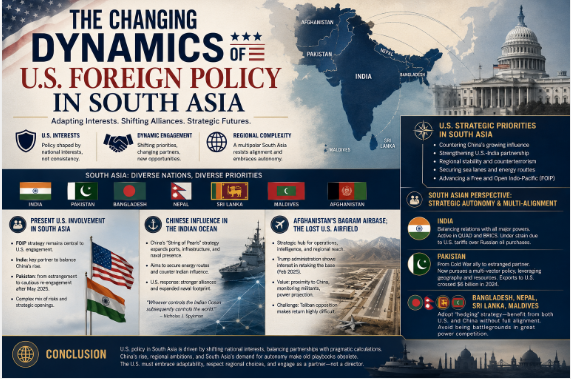
The USA’s interest in South Asian countries is highly influenced by its national interests. In the past, its policy toward this region has not remained consistent; it has changed repeatedly according to its evolving interests. Currently, the country is highly active in the region. Moreover, the USA has been engaged with Pakistan since May 2025, following Pakistan’s aggressive response to India, one of the world’s emerging economies. This reaction was unexpected by the USA and significantly changed its perception of Pakistan.
Present US involvements in South Asia
Donald Trump’s re-election as the 47th President of the United States has reshaped the U.S. foreign policy in South Asia. Within very first days of his second term notable changes have begun to reshape the region’s dynamics. The new policy toward South Asia begins with the establishment of the free and open Indo-Pacific (FOIP) strategy by trump administration in 2017, which remains central to the US engagement in South Asia during his second term. The strategy aims to counter China’s growing economic and military influence. Furthermore, its core is the U.S-India partnership, which administration frame as essential to containing Beijing. India is considered as close ally of Washington and its growing opposition to China’s Belt and Road Initiative have hardened its role in proceeding U.S ambitions across the Asia-Pacific region.
Besides, for Pakistan recent progress is a mixture of both risks and strategic openings. The risk accelerated Pakistan inclination with China, through different initiatives
Some analysts have speculated that Donald Trump might seek to bring Pakistan back into the fold as a key American ally in South Asia. But this possible rapprochement is driven by wider strategic calculations, rather than bilateral considerations alone, the country has remained ally of U.S on multiple periods of time ,and now its capabilities through which it destroyed powerful technology of growing economy India, was surprising and unexpected for U.S. Besides, U.S has already been engaged with India on vast area of cooperations. India is more important for U.S interests as it is one of the growing economies in South Asia means, it is only power in the region that can limit China’s growing influence. On the other hand, U.S is unhappy with certain places like India’s purchase oil from Russia and its’s multi-alignment policy in BRICS, though their working-level cooperation remains strong. On the contrary India remains more significant for long term U.S strategic interests.
Chinese influence in the Indian Ocean
In the past three decades China has expanded its influence in the Indian ocean region through ‘string of pearls’ strategy, which include infrastructure development, port operation, and growing naval presence which aims to secure energy routes and counter Indian influence. The move has fueled Washington’s anxieties, prompting the U.S. to bolster alliances and expand its naval footprint to maintain its regional sway. Indian ocean geopolitics hold great significance among China, U.S and India. As Nicholos John Spkyman said that whoever controls the Indian ocean subsequently controls the world.
Afghanistan’s Bagram airbase; the lost US airfield
U.S. withdrawal from Afghanistan left important American technology arsenals and most importantly its Bagram air base that means a lot for U.S. The news came into fire when president Trump in media briefing in February 2025, has shown interest in retaking the former U.S military base. Before, delving into more details it is important to know about the Bagram air base. So, the base which has two runways- one 3.6km long and the other 3km lies about 31 miles outside Afghanistan’s capital, Kabul. It’s been a strategic area for the many military powers that have ruled – and fought over – Afghanistan. Until 1991, The airfield remained in control of Soviet Union later in control of northern alliance. After NATO invasion of Afghanistan in 2001, U.S gained control of the base and it became strategic centerpiece of military’s presence in country. It was used for multiple purposes like hosting detainees of Afghan the base remained a home to fully functioning hospital for thousands of U.S soldiers. Now why trump is willing to take it back? First of all, retaking this base from Taliban is not an easy task it requires huge military redeployment, thousands of troops and cooperation from the Taliban- which has firmly rejected the idea. So, Trump wants to retake this airfield because of its huge strategic importance and for the means of its national interests including, projecting US power in the South and Central Asia. By controlling Bagram base the country will be able to monitor militant groups and regional development. Along with these trumps sees the base as valuable because its proximity to China, that means it is near to location where China tests and develop its nuclear weapons. On the contrary, retaking lost base would be extremely difficult because the Taliban is vehemently opposed to any return of foreign military forces to Afghanistan.
The south Asian perspective on strategic autonomy and multi-alignment
South Asian countries are not taking any specific side between US and China, and they are managing both relationships for their interests.
India
India acquires US help in countering China but refuses to become a pro American ally. It proves that India’s foreign policy rests on ‘Strategic autonomy’, means it balances relations with all major powers rather than choosing sides. The best example of this is, India is an active member of the both QUAD and BRICS. However, this approach of India is under strain as the US under president trump imposed significant tariffs on its goods, due to the country’s purchase of oil from Russia.
Pakistan
Pakistan worked closely with the United States during the Cold War through alliances like SEATO and CENTO. However, disappointment with uneven US support pushed Pakistan to seek different partnerships. This period of disappointment made country friendly ties with China. As of 2026, the country carries a multi-vector approach, engaging and balancing relations with almost all major powers. In the context of US, it has leveraged strategic geography by granting US access to oil and rare earth minerals in different areas. In 2024, exports to US crossed 6$ billion. That clearly shows its active engagement with major powers.
Bangladesh, Nepal, Sri Lanka, and the Maldives
These smaller states of South Asia have increasingly become entangled India-China competition. These states follow an approach of ‘hedging’ to get benefits from both sides without full alignment. China has been trying challenge India’s traditional sphere of influence through investment, trade, and investment. On the contrast, no south Asian nation wants to be battleground for great power competition. Instead, they follow a multi-alignment approach.
Conclusion
So, upon considering all the fact, we came to know that US does not pursue fixed policy towards South Asia, its policies are largely influenced by its national interest that’s swings between strategic partnerships and conditional cooperation. The return of the Trump administration has revived the Indo-Pacific strategy and strengthened relations with India as the main bulwark against Chinese influence but also forced a recalibration of its view of Pakistan after the latter’s surprisingly assertive military capabilities. China’s growing footprint in the Indian Ocean, the symbolic and strategic appeal of Afghanistan’s Bagram Airbase, and the unshakeable resolve of South Asian nations, from New Delhi to Colombo, to strategic autonomy and multi-alignment, all defy any kind of hegemonic domination. Ultimately, the United States cannot simply recreate old alliances or call the shots. It has to deal with a complicated, multipolar world where even its closest allies refuse to pick sides. the United States will need to replace its inconsistent approach with one of adaptability; develop real respect for the way that the countries in South Asia are defining and developing their own status.
Posted in Diplomacy

From a line drawn in 1914 to a standoff at Taksing in 2026, the eastern…