

Diplomacy
Arunachal’s Restless Frontier: Why the India-China Border Is Heating Up Again
By Sameer Hussain |
From a line drawn in 1914 to a standoff at Taksing in 2026, the eastern…


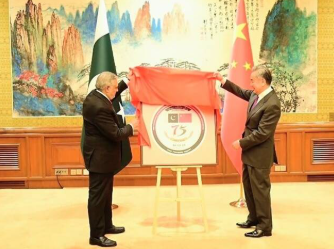
The relationship between Pakistan and China has transformed from a strategic alignment during the Cold War to a comprehensive and multidimensional strategic partnership, that is marked by deep political, economic, military and diplomatic convergence. The relationship, which has its roots in early diplomatic recognition (1951), the 1963 border agreement, wartime support in 1965 and 1971, nuclear and missile cooperation in the 1970s-1980s, and post-9/11 continuity, entered a new transformative phase with the launch of the China Pakistan Economic Corridor (CPEC) under China’s Belt and Road Initiative in 2013. Which has been giving Pakistan benefits in multiple aspects. The CPEC has generated many jobs and employment opportunities for the people of Pakistan. The relationship between both countries is now became strong, as, Pakistan has a confident trust in China, as it never expressed displeasure with its relations with the western powers. Mutual trust between the both is strengthened by consistent Chinese support on Kashmir, NSG membership and veto in UNSC and Pakistan’s support on Xinjiang, BRI and One-China policy. Before delving into deep details, it is important that we must know about background of relations.
Historical Background
Pakistan was the first countries to recognize the People’s Republic of China in 1950. On January 4, 1950, three months after China’s freedom, the country received its first high-level official delegation. However, the ties of friendship date back to the historic Silk Road, which allowed Chinese traders to pass via Pakistan on their business journeys to the Middle East, Europe, and the rest of the world. Famous people like the monks Fa Xian and Xuan Zang passed through what is now Pakistan more than 2,000 years ago.
With every day and year that goes by, this relationship which was founded on the strength of successive achievements becomes more powerful. Both nations’ leaders are dedicated to advancing this partnership.
The relationship deepened significantly in the 1960s, with an agreement on the boundary signed in 1963. Pakistan also played an important role in opening diplomatic channels between China and the United States in the early 1970s and has always supported the one-China principle. On the other hand, India became a strategic concern for both countries for that purpose both inclined toward each other following the border conflict between China and India in 1962, known as Ladakh issue. With little chance of a border adjustment between China and India
Later, China and Pakistan signed the Treaty of Friendship’ for the purpose of Cooperation and Good relations in 2005, and in 2015 the relationship was transformed to a “All-Weather Strategic Cooperative Partnership, after China introduced its new project CPEC with initial budget of 46$bn.
The China-Pakistan Economic Corridor (CPEC)
The China-Pakistan Economic Corridor (CPEC) is a multibillion-dollar project and the flagship model of China’s Belt and Road Initiative. The $62 billion project is aimed to connect Pakistan’s Gwadar Port with China’s Xinjiang region through an extensive network of highways, railways and energy pipelines to enhance regional connectivity and economic growth. It represents a partnership built on years of cooperation, long term mutual trust and mutual respect, and a common vision for the future. Besides, CPEC provides China a shortest route to Arabian sea. In addition to gradual advancements on major projects, recent events point to a recalibration toward CPEC Phase-II, which will work on industrialization, modernization of agriculture, cooperation in research and technology. Nine additional SEZs and agricultural cooperation zones were approved at the 14th Joint Cooperation Committee meeting, which took place in September 2025. In which High value smart farming was the main focus of trial projects in Punjab and Sindh. After being postponed due to disagreements over funding, the ML-1 railway project moved forward with a revised $6.8 billion.
Diplomatic and Strategic Base
In a changing regional security environment, the military and defense aspect of Pakistan-China relations has become a key part of their strategic partnership. This relationship includes significant arms sales, joint military exercises, training initiatives, and intelligence sharing that show their mutual trust. On the other hand, China is Pakistan’s main supplier of military needs. That include air force fleet like the Thunder 17, J10c, and ZDK-03 which is an airborne early warning aircraft, which provide essential military support.
China’s diplomatic backing for Pakistan is another major aspect of their strong ties. China supports Pakistan in international forums such as the NSG and UNSC vetoes. It has also backed Pakistan’s position on the Kashmir issue. Beijing has always defended Pakistan’s stance, criticized Indian actions in Jammu and Kashmir in comments and raising the issue in informal united nation security meetings. On Pakistan’s part, Islamabad has also defended China’s activities in Xinjiang, describing them as internal counterterrorism efforts and rejecting Western claims of human rights violations, as indicated by Pakistan’s co-sponsorship of a 2023 UN declaration endorsing Beijing’s approach.
Moreover, Pakistan has maintained a neutral stance regarding Taiwan and Hong Kong. The country avoided criticism during the 2019-2020 protests in Hong Kong and reiterated the One-China policy in 2024 amid rising tensions in the Taiwan Strait. This support highlights unilateral stance. China gains a Muslim-majority ally to legitimize its domestic policies and expand the geopolitical reach of the Belt and Road Initiative (BRI). Meanwhile, Pakistan benefits economically and in terms of security. However, this alignment limits Islamabad’s foreign policy flexibility on international human rights issues.
Future Cooperation Domains
The China-Pakistan Economic Corridor (CPEC) is about to enter a new phase known as CPEC 2.0, which is centered on high-quality development via industry, modernization of agriculture, and expansion in the digital economy. The new plans will mainly work on modernization of agriculture, as Agriculture stands as a fundamental pillar of Pakistan’s economy making a substantial contribution to foreign exchange earnings, jobs, and GDP. In November 2018, China and Pakistan signed a Memorandum of Understanding (MOU) regarding agricultural cooperation and established a dedicated Joint Working Group (JWG) under the framework of the China-Pakistan Economic Corridor (CPEC) in recognition of the potential of the agriculture sector for the development of Pakistan’s economy. Along with that, both countries are planning to work on space technology which will open a new phase of bilateral ties between the neighbor countries. Ultimately, The relationship’s long-term viability will depend on Pakistan’s capacity to negotiate fair terms, increase domestic ownership of CPEC, and pursue multi-alignment to prevent over-dependence. In the end, the relationship’s resilience stems from its alignment with core national interests on both sides.
75th Anniversary Commemorations
The 75th anniversary commemoration include High-level visits and cultural events are part of the 75th anniversary celebrations. In May 2026, a Chinese delegation headed by NPC Standing Committee Vice Chairman Cai Dafeng traveled to Islamabad. Members of the delegation watched proceedings in the National Assembly and Senate from the visitors’ galleries, where they were formally received by legislators across the political spectrum. Additionally, Dar informed the Senate that Prime Minister Shehbaz Sharif and a high-level team would make an official visit to China from May 23 to May 26. He stated that the trip would involve talks under the Pakistan-China Political Forum and the CPEC Joint Consultative Mechanism, as well as events related to the 75th anniversary of diplomatic relations and meetings with Chinese leaders, including President Xi Jinping and Premier Li Qiang. A formal resolution reiterating Pakistan’s commitment to the relationship and CPEC was passed by the Senate. In official speech, the alliance is frequently described as “higher than the mountains, deeper than the oceans, stronger than steel, and sweeter than honey.

From a line drawn in 1914 to a standoff at Taksing in 2026, the eastern…