Diplomacy
Arunachal’s Restless Frontier: Why the India-China Border Is Heating Up Again
By Sameer Hussain |
From a line drawn in 1914 to a standoff at Taksing in 2026, the eastern…




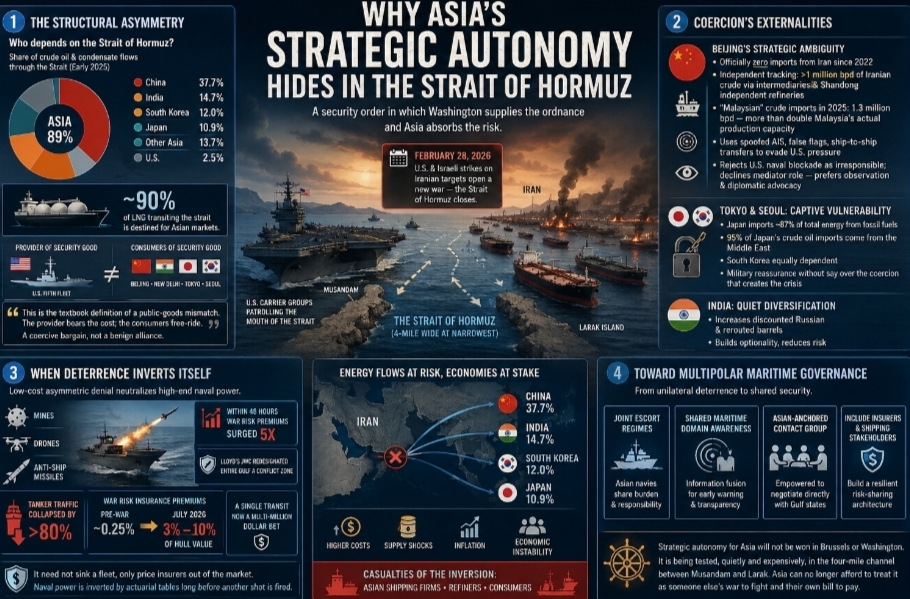
When American and Israeli strikes on Iranian targets opened a new war on February 28, 2026, the resulting closure of the Strait of Hormuz produced a scene that should embarrass anyone still describing Gulf security as a Western strategic interest. U.S. carrier groups patrolled the mouth of the strait while the tankers stranded behind them, and the economies bleeding from the blockade, were overwhelmingly Asian. This is not a new asymmetry, but 2026 has made it impossible to ignore. It is time to name the arrangement for what it is: a security order in which Washington supplies the ordnance and Asia absorbs the risk.
The Structural Asymmetry
The numbers are not subtle. As of early 2025, Asian economies received roughly 89 percent of the crude oil and condensate that transited the strait, with China alone accounting for 37.7 percent of total flows, followed by India at 14.7 percent, South Korea at 12 percent, and Japan at 10.9 percent. The United States, by contrast, received a marginal 2.5 percent of these flows, a reflection of the shale revolution’s success in insulating American energy security from a chokepoint its navy still dominates. On the LNG side the picture is equally stark: almost 90 percent of the LNG transiting the strait in 2025 was destined for Asian markets. This is the textbook definition of a public-goods mismatch. The provider of the security good, the U.S. Fifth Fleet, bears the military and reputational cost of deterrence; the consumers of that good are Beijing, New Delhi, Tokyo, and Seoul, who contribute negligible force posture to the strait’s defense. Realist alliance theory calls this a classic free-riding dilemma, but that framing flatters Washington. The more accurate description is a coercive bargain: Asian economies purchase energy security by proxy, at the price of accepting that Washington alone decides when and how to escalate against Iran.
Coercion’s Externalities
The 2026 war has exposed how badly unilateral coercive diplomacy travels once it collides with Asian economic interests that Washington does not share. Beijing’s response has been instructive. Despite formally recording zero imports from Iran since 2022, independent tracking suggests Iranian crude routed through intermediaries and processed by independent refineries in Shandong has exceeded a million barrels a day in recent years, and Chinese “Malaysian” crude imports in 2025 reportedly reached 1.3 million barrels per day, more than double Malaysia’s actual production capacity. This is what asymmetric bargaining theory would predict: the weaker party facing a stronger coercer does not comply, it evades, using spoofed AIS transponders, false flags, and ship-to-ship transfers to route around American pressure rather than confront it. Beijing has simultaneously hedged diplomatically, rejecting the U.S. naval blockade as irresponsible while declining the direct mediator role Washington has invited it to play, preferring instead the safer posture of observation and diplomatic advocacy. That is not neutrality; it is strategic ambiguity designed to preserve options in a conflict Beijing did not choose and cannot control.
Tokyo and Seoul enjoy no such hedge. Japan draws roughly 87 percent of its total energy use from imported fossil fuels, with 95 percent of its crude oil imports originating in the Middle East, leaving it, along with South Korea, structurally captured by an alliance architecture that offers military reassurance but no say over the coercive diplomacy that produces the crisis in the first place. This is the paradox at the heart of Atlanticist extended deterrence applied to Asia: it protects the sea lanes while amplifying the very volatility that threatens them, and it does so without consulting the states paying the economic price.
When Deterrence Inverts Itself
The most consequential shift, however, is technological, not diplomatic. Washington’s naval primacy was built for an era of state-on-state blue-water contests. It is comparatively impotent against dispersed, low-cost asymmetric denial. Iranian mines, drones, and anti-ship missiles have repeatedly closed a waterway that no U.S. carrier group could keep open. Within 48 hours of the February strikes, war risk premiums surged fivefold, and Lloyd’s Joint War Committee redesignated the entire Gulf a conflict zone, collapsing tanker traffic by more than 80 percent. By July, brokers reported premiums had climbed from a pre-war baseline near 0.25 percent of hull value to between 3 and 10 percent, transforming a single transit into a multimillion-dollar bet. This is the real mechanism of asymmetric maritime denial: it need not sink a fleet, only price insurers out of the market. Naval power projection is inverted by actuarial tables long before a single additional shot is fired, and the casualties of that inversion are Asian shipping firms, refiners, and, ultimately, consumers.
Toward Multipolar Maritime Governance
None of this is sustainable as a permanent equilibrium. A security order in which the guarantor’s exposure is minimal and the beneficiaries’ exposure is existential cannot generate durable buy-in, and Beijing’s evasive hedging, Tokyo and Seoul’s captive vulnerability, and India’s quiet diversification toward discounted Russian and rerouted barrels are all symptoms of that failure. What the strait actually demands is a shift from unilateral American deterrence to a multilateral maritime security architecture that gives Asian navies, coast guards, and insurers a formal stake, whether through joint escort regimes, shared maritime domain awareness, or an Asian-anchored contact group empowered to negotiate directly with Gulf states. Strategic autonomy for Asia will not be won in Brussels or Washington. It is being tested, quietly and expensively, in the four-mile channel between Musandam and Larak, and the region’s great powers can no longer afford to treat it as someone else’s war to fight and their own bill to pay.
Posted in Politics and Society, Security and Peace

From a line drawn in 1914 to a standoff at Taksing in 2026, the eastern…