Diplomacy
Arunachal’s Restless Frontier: Why the India-China Border Is Heating Up Again
By Sameer Hussain |
From a line drawn in 1914 to a standoff at Taksing in 2026, the eastern…




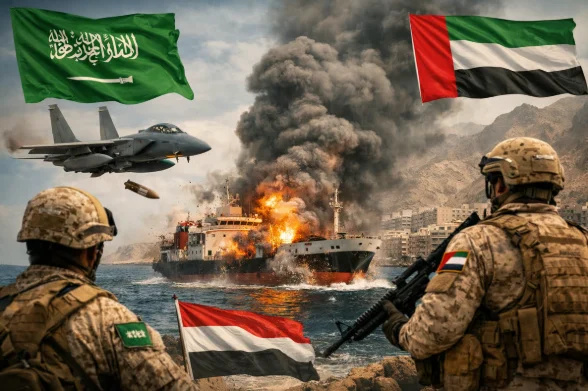
For a month, the Mecca Joint Defense Agreement between Saudi Arabia, Türkiye and Pakistan existed mostly as an idea, uniting the Islamic world’s only nuclear power, NATO’s second-largest army, and the Gulf’s deepest pockets. Its drafters called it a contingency arrangement: reactive, defensive, triggered only by unprovoked aggression against a signatory. Everyone else read it differently. India saw a veiled hedge against itself; Iran saw a Sunni-Gulf-Pakistani axis aligning against it; Israel saw a nuclear umbrella extending, however ambiguously, over Riyadh. All three readings were speculative, because the pact had never been used. That changed this week.
Houthi missiles and drones have been battering Saudi territory with an intensity not seen since the 2022 truce collapsed, striking an airbase at Khamis Mushait, Aramco infrastructure near Abha, and cities including Jazan, wounding dozens. Pakistan’s Defense Minister Khawaja Asif responded by stating plainly that continued spillover into Saudi Arabia would make the Mecca agreement operational. Reuters has since reported that Islamabad delivered a Saudi-backed warning directly to Tehran, urging it to restrain the Houthis, even as Iranian sources indicated Tehran had in fact instructed the group to escalate and dispatched IRGC officers to help coordinate the campaign. Separately, Pakistani sources have told regional media that Islamabad is weighing direct airstrikes against Houthi positions inside Yemen at Saudi request, with clearing Houthi-held Saada province floated as an early objective, though officials insist no final decision has been made and that any response would, for now, be launched from Saudi soil rather than Pakistani boots on Yemeni ground.
This is precisely the moment analysts of the pact should have been waiting for, because pacts are defined less by their text than by their first invocation. The Mecca agreement’s founders always framed it as narrow: a mutual-defense clause modeled on NATO’s Article 5, activated only by direct aggression against a member’s territory. The Houthi crisis is, in a strict sense, exactly that kind of test, an outside actor striking Saudi Arabia, not Pakistan or Türkiye pursuing outward ambition. If Islamabad limits itself to what officials describe as technical, logistical or air-defense support delivered from inside the Kingdom, the pact will have behaved exactly as advertised: a shield, not a sword. That would go some distance toward deflating the narrative, popular in New Delhi and Tehran alike, that the agreement is really an offensive coalition in defensive clothing.
But if Pakistani jets end up striking Houthi targets inside Yemen, even at Riyadh’s explicit request and even framed as protecting Saudi territory from a “spillover”, the character of the pact changes; contingency becomes power projection. A defensive commitment starts to look like a member state’s air force fighting a foreign group’s war, on foreign soil, at an ally’s request. That is not a hypothetical India or Iran can be talked out of; it is the precedent both have been warning about since the ink dried in August. Pakistan crossing into Yemeni airspace would hand New Delhi’s argument that Mecca is a vehicle for Pakistani military reach beyond South Asia an evidentiary basis it currently lacks, regardless of how carefully Islamabad frames the mission as Saudi-requested and Houthi-specific. It would also make Iran’s insistence that the pact was conceived, at least partly, with hostile intent toward it far harder for Islamabad and Riyadh to wave away diplomatically, whatever the private assurances exchanged in Riyadh between Saudi, Pakistani and Turkish military officials this week.
A second, quieter story is Pakistan’s ongoing, and largely unproductive, mediation between Washington and Tehran. Islamabad has spent months positioning itself as a channel capable of talking to both sides, most visibly through its floated memorandum of understanding as a framework for de-escalation. This effort has been sustained and high-visibility but so far barren of any concrete breakthrough. The Houthi episode threatens to strip away what little diplomatic capital that mediator role gave Pakistan with Tehran. A Pakistani air campaign against an Iranian-armed proxy, however narrowly justified as Gulf self-defense, is not something Tehran will file away as unrelated to the broader US-Iran file. It will read it as Islamabad picking a side in a conflict it had claimed to stand outside of.
That, in turn, reshapes the strategic geometry of the wider confrontation. One of Iran’s few remaining forms of leverage has been the ability to raise costs asymmetrically, through the Houthis against Saudi oil infrastructure and Red Sea shipping, and through its closure of the Strait of Hormuz. If Pakistani involvement helps blunt the Houthi threat to Saudi territory, it removes one of the few pressure points Tehran can apply against a US-aligned Gulf state without confronting American forces directly. Riyadh and Washington would, on net, be relieved: a second front partially neutralized, and a Gulf-Pakistani coordination structure that could plausibly be pointed at future contingencies too. For Iran, that outcome would confirm what its officials have suggested privately for weeks: that Mecca is becoming, in practice if not in name, machinery for containing Iranian-aligned actors, folding a US-Iran bilateral standoff into a more crowded, multilateral confrontation involving Pakistan and Türkiye by extension.
A widening-circle dimension is also worth watching, and Bangladesh is the clearest test case. Dhaka has been unusually forthcoming about joining Mecca, with senior officials calling the pact a positive step in parliament and suggesting accession would not constrain Bangladesh’s other partnerships. That enthusiasm was voiced when the agreement was still theoretical, a symbolic marker of Islamic-world solidarity and a hedge for Indian Ocean shipping security, costing Dhaka nothing to praise. The Houthi crisis changes what accession would actually mean. If membership now carries potential entanglement in a Gulf-Yemen war or the Pakistan-Iran friction trailing it, that is a far heavier commitment than the one Bangladeshi officials gestured toward in August. Dhaka sits far from the Gulf and has no direct stake in the Houthi conflict, the Saudi-Iran rivalry, or Pakistan’s western-border concerns the pact was partly built around; domestic commentators have already warned that formal membership could compromise the country’s traditional non-alignment for security problems that are not its own. Bangladesh’s leadership must now decide whether its stated openness survives contact with a pact that looks less like a symbolic gesture and more like an active military commitment with real escalation risk, and how Dhaka’s answer will signal how seriously other prospective partners take the gap between Mecca’s contingency language and its emerging practice.
None of this is foreordained. Pakistani and Saudi officials have been notably careful to signal restraint, insisting no strike decision is final and that Riyadh’s own response will target Houthi capability rather than Iran directly. But restraint is a choice made anew with every attack, and the Houthis have shown no inclination to stop. The next Saudi city hit, the next round of Pakistani deliberation over Saada, will do more to define what Mecca actually is, shield or spear, contingency or coalition, than any communique signed in August ever could. That debate will not be settled by what Riyadh, Ankara and Islamabad say about it. It will be settled by what Pakistan’s air force actually does over Yemen, and by how Tehran and Dhaka choose to answer.
Posted in Security and Peace

From a line drawn in 1914 to a standoff at Taksing in 2026, the eastern…