Diplomacy
Arunachal’s Restless Frontier: Why the India-China Border Is Heating Up Again
By Sameer Hussain |
From a line drawn in 1914 to a standoff at Taksing in 2026, the eastern…



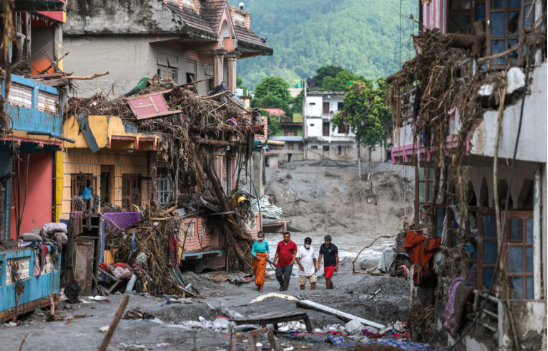
Nepal has been struck by a disaster that no family should have to endure. We owe its victims our condolences and its people our solidarity. But we also owe them something more: the willingness to listen, because the siren sounding in Nepal today may, if we fail to act, be heard tomorrow in Bangladesh. “Simon Mohsin”
Nepal is mourning. Entire communities have been devastated, families are searching for loved ones, and a disaster of extraordinary force has swept away roads, bridges, homes, and vital infrastructure. At a moment like this, the first response must be respect: respect for Nepal, for those who have lost their lives, for families waiting desperately for news, and for the rescuers working in extraordinarily dangerous conditions. The disaster along the Nepal-Tibet border is still unfolding. A catastrophic collapse of ice and rock triggered a violent flash flood, sending enormous volumes of debris and water downstream. The scale of destruction has been immense, with hundreds reported dead and more than a thousand people still missing.
But Nepal’s tragedy should also compel Bangladesh to listen. It is a warning siren. Not because Bangladesh faces precisely the same geological circumstances as Nepal; it does not, but because both countries belong to a region where climate change, extreme rainfall, fragile ecosystems, rapid development, population density and inadequate resilience can combine to turn a natural hazard into a national catastrophe. And Bangladesh has already experienced that combination.
An uncomfortable truth behind disasters like this is that the countries suffering some of the most devastating consequences of climate change are often not the countries that created the problem. Nepal’s contribution to historical global greenhouse-gas emissions is tiny. Bangladesh’s is similarly small, particularly in per-capita and historical terms. Yet both countries face consequences generated by a global economic system built for decades around carbon-intensive industrialization, fossil fuels and consumption. The Himalayas are now one of the world’s great climate-warning systems. Rising temperatures are accelerating glacier retreat and destabilizing mountain environments. Scientists warn that warming, permafrost degradation and changing precipitation patterns can increase the risks of avalanches, landslides, glacial floods and cascading disasters.
The precise chain of causation in this particular Nepal disaster will rightly require scientific investigation. It would be irresponsible to claim that climate change alone “caused” the event. But it would be equally irresponsible to ignore the larger climate context in which such hazards are becoming more dangerous. This climate injustice lies at the heart of the Global South’s predicament. The industrialized world became wealthy through an economic model that generated enormous cumulative emissions. Countries such as Nepal and Bangladesh now have to spend scarce resources adapting to a changing climate they did little to create.
Climate justice, therefore, cannot mean simply asking vulnerable countries to become more resilient. It must also mean asking those with the greatest historical responsibility to reduce emissions faster, provide predictable adaptation finance, fund loss and damage, transfer technology, and stop treating climate assistance as charity. In an increasingly unequal global distribution of climate risks, this is not merely assistance; it is a matter of responsibility and justice.
Bangladesh should not wait for its own Nepal moment. Bangladesh knows what disaster looks like. Floods, flash floods, cyclones, river erosion and landslides have become recurring features of national life. In July this year alone, heavy rainfall, upstream runoff and landslides affected more than 1.11 million people across 10 districts. The country’s geography makes it particularly exposed. Bangladesh sits downstream of the Himalayan river system and at the head of the Bay of Bengal. What happens in the mountains does not necessarily stay in the mountains. A warming Himalaya is therefore not merely a Nepalese concern. It is also a Bangladeshi concern.
But our vulnerability goes beyond floods. The Chittagong Hill Tracts are increasingly exposed to intense rainfall, flash floods and landslides. A UN-supported climate vulnerability assessment has specifically identified erratic rainfall, heavy rainfall-induced landslides and flash floods as major risks in the region. For communities in mountainous and remote areas, the combination of fragile terrain, intense rainfall, and limited access to emergency services can turn a severe weather event into a humanitarian emergency with extraordinary speed.
Then there is the earthquake question. Bangladesh is not Nepal, but it is not earthquake-proof either. Parts of the northeast, Chattogram and the Chittagong Hill Tracts are recognized as earthquake-prone areas. Dhaka’s enormous population density, aging or poorly constructed buildings, narrow roads and limited emergency access could transform a major earthquake into a humanitarian crisis. The danger is not simply the earthquake itself; it is the possibility of cascading failures in buildings, roads, utilities, hospitals, communications and emergency response systems.
In the Chittagong Hill Tracts, the consequences could become even more complicated. The Kaptai Dam and reservoir are critical pieces of national infrastructure. Any serious seismic event in the region demands that we ask difficult questions about the dam’s structural integrity, downstream consequences, and emergency evacuation capacity. This is not a prediction that an earthquake will destroy Kaptai Dam. It is an argument for refusing to wait for an earthquake to give us the answer. A comprehensive, independent assessment of the dam’s seismic and structural resilience, coupled with downstream risk modeling and emergency preparedness, is therefore not alarmist. It is prudent governance.
Bangladesh has already learned that prevention is cheaper than recovery. Indeed, the country has achieved remarkable success in disaster preparedness. The World Bank notes that Bangladesh has reduced cyclone-related deaths by roughly 100-fold since 1970. That achievement should give us confidence, but not complacency. The risks facing Bangladesh are changing, and the country’s disaster-management strategy must evolve accordingly.
Nepal’s tragedy should not produce panic in Bangladesh. It should produce preparation. The government needs to treat climate and disaster resilience as matters of national security. That means expanding real-time early-warning systems for flash floods, landslides, and extreme rainfall; developing high-resolution hazard maps; enforcing building codes; conducting systematic seismic audits of schools, hospitals, bridges, and other critical infrastructure; and establishing credible evacuation plans for Dhaka, Chattogram, and the Chittagong Hill Tracts. Kaptai Dam deserves a comprehensive, independent seismic and structural safety assessment, including worst-case downstream inundation modeling and community-level evacuation planning.
Urban development must also change. We cannot continue filling wetlands, narrowing drainage channels, building on unstable slopes and expanding settlements without considering what happens when extreme rainfall arrives. Development that ignores ecological limits may generate short-term economic gains, but it can also create long-term public vulnerability. Resilience must therefore become an integral component of how Bangladesh plans its cities, infrastructure, and economic expansion.
But responsibility does not end with government. Climate resilience is also a community project. Residents need to know their evacuation routes. Schools should conduct regular earthquake and flood drills. Communities in landslide-prone areas should understand warning signs and emergency procedures. Buildings should be inspected, local volunteers trained, and families encouraged to maintain basic emergency supplies and communication plans. Disaster preparedness cannot begin when the disaster has already arrived.
Citizens must also stop treating environmental destruction as someone else’s problem. Cutting hills, occupying wetlands, blocking drainage channels, dumping waste into waterways, and constructing recklessly may generate short-term private benefits, but collectively they create public vulnerability. Every illegally filled wetland, every hill cut for development and every drainage channel blocked by unplanned construction contributes to a Bangladesh that is less capable of absorbing environmental shocks.
The people of Nepal deserve solidarity, assistance, and time to grieve. Their tragedy should never be reduced to a convenient climate-change talking point. But their suffering carries a message that Bangladesh cannot afford to ignore. The climate crisis is no longer a distant forecast. It is becoming a crisis of cascading risks: glacier collapse followed by flash floods; extreme rainfall followed by landslides; earthquakes followed by infrastructure failure; and extreme weather followed by displacement, disease, economic loss and social disruption.
For Nepal, the immediate task is rescue, relief and recovery. For Bangladesh, the task is preparation. The developed world must finally recognize that climate responsibility is not limited to announcing emission targets. It must deliver deep emissions reductions, climate finance, technology, adaptation support and meaningful loss-and-damage assistance to countries on the front lines of the climate crisis. The countries that contributed least to the problem should not be left to shoulder its greatest consequences alone.
Bangladesh, meanwhile, must recognize that international climate justice cannot replace domestic responsibility. We need stronger institutions, better planning, safer infrastructure, rigorous scientific risk assessment and communities capable of responding before disaster becomes catastrophe. Government must lead, but citizens must participate. Resilience must be built not only into national policy but also into neighborhoods, schools, workplaces and households.
The choice is not between development and resilience. The choice is whether we build development that can survive the future. A country as densely populated, geographically exposed and economically ambitious as Bangladesh cannot afford to treat disaster preparedness as an occasional emergency exercise. It must become a permanent feature of governance and national planning.
Nepal has been struck by a disaster that no family should have to endure. We owe its victims our condolences and its people our solidarity. But we also owe them something more: the willingness to listen, because the siren sounding in Nepal today may, if we fail to act, be heard tomorrow in Bangladesh.
Posted in Anthropocene, Security and Peace

From a line drawn in 1914 to a standoff at Taksing in 2026, the eastern…