Diplomacy
Arunachal’s Restless Frontier: Why the India-China Border Is Heating Up Again
By Sameer Hussain |
From a line drawn in 1914 to a standoff at Taksing in 2026, the eastern…




The sea, once a natural frontier, is now a new competition ground. Underwater drones are changing the way major powers scout, protect, and destroy undetected. The underwater world is no longer ‘no man’s land,’ but ‘every man’s game.’
When the Houthi rebels in Yemen assaulted a Saudi vessel by maritime drone in January 2017, then the little-known development of sea-capable semi-autonomous weaponry came to light and this depicts that the Modern warfare is far more than traditional warfare on a battlefield. Once the oceanic waters which are huge, obscure, and difficult to control, around the world now have suddenly become much clearer, more competitive, and highly valued strategically. This shift owes much to the development of underwater drones, also known as Unmanned Underwater Vehicles (UUVs). These unmanned craft, ranging from small sensing devices to large warships, will change how nations view power projection in the oceans. In much the same way that unmanned aerial vehicles revolutionized warfare in the early decades of the 21st century, unmanned underwater vehicles are now vital in the world of naval warfare and geopolitics. Today, countries are fighting for technological superiority in the depths of the ocean by using unmanned underwater drones to strengthen their navies’ defensive plans. The UUV are not only futuristic ideas but also powerful tools that would change military operations around the world.
The Strategic Development of Underwater Drones
There are two forms of underwater drones Autonomous Underwater Vehicles (AUV) which can perform independently through use of artificial intelligence and programming commands and the other one is Remotely Operated Vehicle (ROV) which is operated by human handlers. They can conduct patrolling operations, mapping of the sea bed, locate and hunt submarines, defend sub-marine assets, and deliver payloads. The ability to conduct operations in a domain where high cost-high risk platforms such as submarines are normally used is what makes underwater drones game-changing. They are inexpensive, difficult to detect, and can remain submerged underwater for an extended period of time they decrease the risk of human life.
A Novel Approach to Naval Combat
UUVs have brought about major changes in naval warfare by virtue of their stealth, persistence, and asymmetry. As opposed to other naval platforms, the unmanned undersea vehicle is capable of trailing submarines, spying on the activities of the adversary, and gaining intelligence in the contested waters. Utilization in Anti-Submarine Warfare (ASW) constitutes one of the greatest breakthroughs because of the immense size and depth of the sea.
However, underwater drone constellations equipped with sensors and sonars have the ability to construct a “digital underwater grid,” making detection easier. As for the ballistic missile submarines that are considered to be the most invulnerable aspect of nuclear triads, they will be more vulnerable due to this development, which poses a great effect on nuclear deterrence. Additionally, the application of underwater drones in the field of mine warfare is increasing. They are far more efficient when compared to the traditional methods concerning identification, mapping, and destroying mines underwater. Nevertheless, these underwater drones can be employed for secretly laying of mines as well.
Undersea Infrastructure Protection and Vulnerability
In the 21st century when the whole world is connected with each other sharing vital infrastructure such as submarine transmission cable, energy pipelines, oil riggs lie under the ocean, these assets carry over 95% of global internet traffic and are essential for economic stability. Then in 21st century UUV comes with its both side of coin. Like protection of infrastructure against underwater drones and sabotage of infrastructure with them are on the rise as important elements of modern warfare. While on the one hand, such devices could ensure security and protection of pipelines and cables through inspection of them, but they can also serve as weapons of espionage and sabotage. The problem of vulnerability of this underground infrastructure was noted in cases when undersea cables were damaged.
The ability to either defend or interfere with underwater infrastructure is now considered a new element of competition between superpowers that takes place at an infrastructural level rather than being a military affair.
Under the Waves: Undersea Great Power Rivalry
Alongside their broader maritime strategy, major power has made substantial contributions towards the development of underwater drones. For instance, within the scope of its broader efforts, the United States is developing the extra-large Orca UUV for extended missions. On the other hand, China is also busy with building their own capacities using underwater drones in order to spy on and threaten their rivals in connection with territorial controversies, particularly concerning the South China Sea.
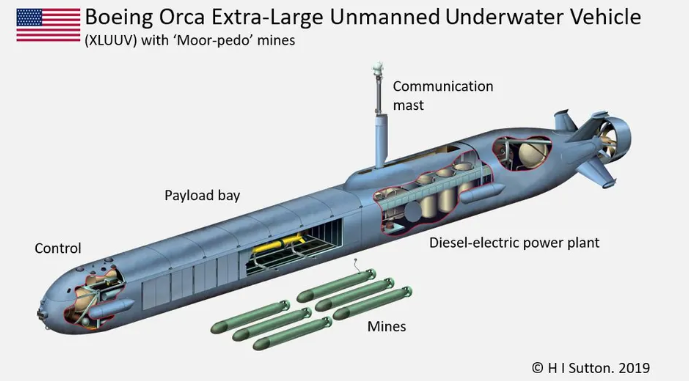
As far as this issue is concerned, the high level of interest in underwater drones that can be used for nuclear attacks on the part of the Russians should be highlighted. From this perspective, the growing significance of the role played by underwater drones is becoming apparent.
With the rising competition of UUV Indeed, the Indo-Pacific region has also experienced increased rivalry in this domain. Given its sea routes, disputed maritime zones, and growing navies, it seems that unmanned submarines have taken on roles beyond mere reconnaissance.
Indian Ocean Situation and Strategic Necessities for New Delhi
The emergence of the underwater drones is a double-edged sword for New Delhi , which is geographically located in the center of the Indian Ocean. India relies on maritime commerce to a large extent; more than 90% of Indian trade is carried out using sea routes. Meanwhile, there are more and more activities being conducted by other nations, especially by China in Indo Pacific. Chinese deployment of underwater drones and research vessels in the Indian Ocean has alarmed India, due to concerns of Chinese surveillance missions and activities with a dual purpose. These vessels, although ostensibly used for research, can provide oceanographic information that helps improve submarine warfare. Given this situation, India should recognize the importance of underwater drones in its maritime security policy and India should invest haveily in R and D proggrames for UUV.
Current Strengths and Innovations of India
Even though it is still in the initial stages in comparison with other major countries, India has also begun making investments in underwater drone technology. Among those who have started developing homegrown projects for UUVs in India are the Indian Navy and DRDO (Defence Research and Development Organization).
Contributions of innovation and efficient utilization of resources are being made by startups and private sector organizations that have entered the market space of UUVs. This is in line with India’s efforts towards achieving self-reliance in defense industry projects such as “Atmanirbhar Bharat.” With this New Delhi sholuld also look and promote its policy of Make in India ,Make for World .
Way Ahead
Underwater drones have quickly revolutionized the dynamics of global power politics by taking the fight for strategic dominance below the surface, where their presence cannot be detected. Being able to monitor, protect, or sabotage vital infrastructure, as well as perform endlessly undetected, underwater drones are an essential element of contemporary geopolitics. With the rising capabilities of great powers in the undersea realm, undersea space represents a new domain of competition that is opaque, unregulated, and inherently unstable.
From an international point of view, the rise of unmanned undersea vehicles has created a contradiction. While that vehicles help in maintaining safety at sea, facilitating scientific research, and enhancing the capability of disaster relief activities, on the other hand, the use of such technology decreases the bar required for espionage, poses threats to the security of critical undersea structures, and also creates a chance of miscalculation among rival nations.
Being a coastal country situated in the middle of the Indian Ocean, India’s economic and strategic concerns depend greatly on water bodies. The increased involvement of other states in the region by way of developing their underwater capabilities calls for the need for India to develop its own underwater capabilities.For this India should look its target of 2030 to make india a a global hun drone. India should strengthen its defence ties with its QUAD partner USA which is doing excssive work in field of UUV .
Both nation should look how to counter china UUV programme in Indo -Pacific to promote their idea of Free and Indo -Pacific(FOIP). The way forward for India is to adopt a two-pronged strategy. On one hand, India needs to develop its own underwater capability through indigenous technology; on the other, India must promote cooperative governance within the region. This will help India secure its national interests, while ensuring its leadership in the underwater world order in the process.
Underwater drones are stealthily revolutionizing the concept of power by bringing the strategic emphasis down to the ocean floor. With each passing day, the underwater environment is becoming more and more contentious, as well as relevant, making it difficult to oversee the activities taking place beneath the ocean surface. The task for the future would be to strike a balance between innovation and stability, making sure that emerging abilities do not trigger an uncontrolled race to power. In essence, those who master the art of managing the hidden realm will define power structures in the coming years.
References
Gallagher, K. (n.d.). From Land to Sea: 5 Ways Drones are Impacting Underwater Operations. https://www.simulyze.com/blog/from-land-to-sea-5-ways-drones-are-impacting-underwater-operations
Posted in Politics and Society, Security and Peace

From a line drawn in 1914 to a standoff at Taksing in 2026, the eastern…