Diplomacy
Arunachal’s Restless Frontier: Why the India-China Border Is Heating Up Again
By Sameer Hussain |
From a line drawn in 1914 to a standoff at Taksing in 2026, the eastern…




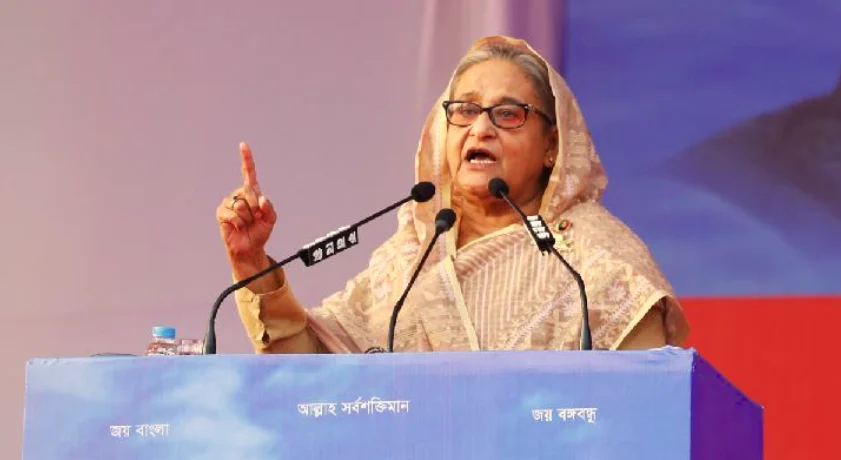
Two years after fleeing Dhaka by helicopter as a student-led uprising overran her government, Sheikh Hasina has done something she had avoided since August 2024: she has put a date on the table. Speaking via video link from New Delhi in August 2026, the former prime minister said she intends to return to Bangladesh by December 2026 despite facing a death sentence at home. In her own words, she may be detained or imprisoned, fabricated verdicts may be enforced against her, but fear cannot decide her duty to the people. The announcement raises a question that is as much about geopolitics as about one politician’s fate: is this return plausible, or is it a political signal aimed at an audience that no longer holds power?
The obstacle she faces is not hypothetical. In November 2025, Bangladesh’s International Crimes Tribunal the same court she herself established to try her political rivals convicted eher in absentia of crimes against humanity, for ordering lethal force against protesters that killed more than 1,400 people during the 2024 uprising and sentenced her to death. The United Nations Human Rights Office had earlier found that her government and party systematically engaged in serious human rights violations during the crackdown, including extrajudicial killings, enforced disappearances, and torture. She has rejected the tribunal’s verdict as politically motivated, but it stands, and Dhaka has treated it as binding. Following the ruling, Bangladesh’s foreign ministry stated that India had an “obligatory responsibility” under the two countries’ 2013 bilateral extradition treaty to facilitate her return a claim New Delhi has pointedly avoided addressing directly.
The more consequential actor in this story may not be Hasina herself but New Delhi. Dhaka has now sent at least three formal extradition requests since Hasina fled, and interim and subsequent Bangladeshi officials have repeatedly said they have received no substantive reply. India has neither granted nor formally refused the request, saying only that it remains “under examination.” This ambiguity is not accidental. Hasina was one of India’s closest regional allies for over a decade, and New Delhi’s backing of her government was widely seen in Bangladesh as tilting the relationship heavily in India’s favour and as complicit in the erosion of democratic space under her rule. Her removal has left India managing a genuine dilemma: extraditing a longstanding ally would be a significant reversal, while continuing to shelter her keeps a running sore in the bilateral relationship. Analysts in New Delhi have suggested India will likely “soft-pedal” the issue rather than resolve it outright, hoping that time and a settled elected government in Dhaka will eventually allow both sides to move past it without a definitive answer.
That patience has a cost, and Dhaka has recently signalled it is no longer willing to simply absorb it. In August 2026, Bangladesh said its new prime minister, Tarique Rahman, would not visit India until Hasina is extradited a direct linkage of high-level diplomatic engagement to her case. At the same time, Bangladeshi officials have also tried to prevent the issue from becoming an absolute veto over the wider relationship, with the interim government’s foreign affairs adviser stating that ties “won’t be stuck on one issue alone,” even while insisting that repatriation is expected “at the earliest possible time.” This is a difficult needle to thread: Dhaka wants extradition to remain a live, pressing demand, while also trying to rebuild a functional relationship with its largest neighbour on other fronts, from trade and water-sharing to border security and the treatment of religious minorities an issue India has itself raised pointedly with Dhaka in recent months.
At home, the political terrain has also shifted decisively away from Hasina. Her party, the Awami League which dominated Bangladeshi politics for most of the past two decades has been banned from the political process and was barred from contesting this year’s general election, which the opposition BNP, led by Tarique Rahman, won with a two-thirds majority. That election result matters directly for her prospects: it was conducted under an administration with every institutional incentive to see the Awami League remain marginalised, and it produced a government now explicitly using the extradition question as leverage against India rather than as an obstacle to be quietly resolved. Analysts following the story read Hasina’s return pledge less as a realistic transition plan than as an attempt to keep the Awami League politically alive from a position of near-total exclusion a homecoming pitched at galvanising a scattered base and reasserting relevance rather than a credible path back to office.
There is a pointed symmetry worth noting. Hasina’s political career itself began with a return from Indian exile in 1981, after her father and most of her family were assassinated a return that became the founding myth of her decades in politics, still marked annually by her party as a “homecoming” day. A second return, under a death sentence, framed by her allies in similar language, appears designed to invoke that story deliberately, casting a second exile as the prelude to a second vindication. But the parallel obscures a very different reality. In 1981 she returned to a party that was in opposition but legal, seeking to rebuild within a functioning, if flawed, political system. In 2026 she would be returning to a state that has already tried and sentenced her to death, to a party that has been formally outlawed, and to a government led by her historic rival that has made her extradition a public precondition for normalising ties with the one country currently sheltering her.
Weighing these factors together a death sentence still standing, an extradition request India has left deliberately unresolved even as it faces growing diplomatic pressure over it, and a party excluded from the political system that would need to shelter her an actual physical return by December looks considerably less certain than the announcement suggests. The more probable near-term outcome is that “return” functions primarily as a political statement rather than a firm travel plan: a way of asserting that Hasina and the Awami League have not disappeared from Bangladeshi politics, and of keeping pressure on India to either act on the extradition request or continue absorbing the diplomatic cost of inaction. Either way, whether Hasina ever again sets foot in Dhaka will likely be decided less by her own resolve than by a calculation made in New Delhi one that, for now, India shows no urgency to finalise.
Posted in Politics and Society

From a line drawn in 1914 to a standoff at Taksing in 2026, the eastern…