Diplomacy
Arunachal’s Restless Frontier: Why the India-China Border Is Heating Up Again
By Sameer Hussain |
From a line drawn in 1914 to a standoff at Taksing in 2026, the eastern…




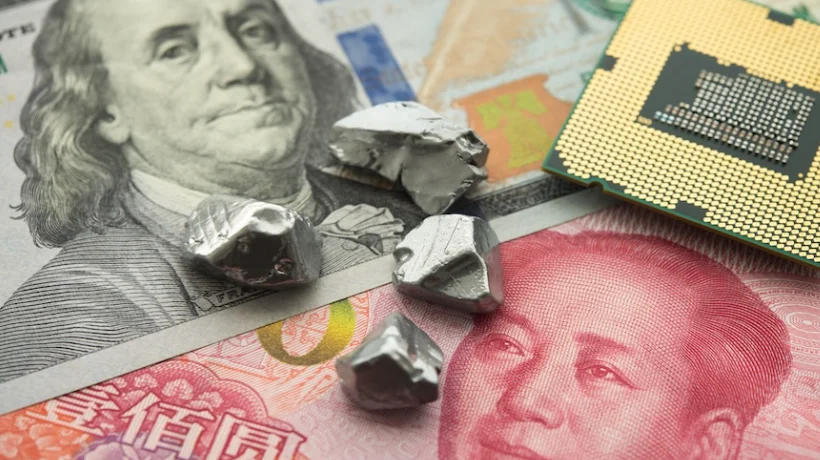
National power was earlier measured in barrels of oil, tons of steel, and warheads, but in today’s era a quieter but no less consequential currency has emerged. Critical minerals have transitioned from being an afterthought in resource policies to being front and centre of industrial policy and security strategy. Lithium, cobalt, nickel, graphite, copper, and rare earth minerals form the bedrock of electric vehicles, energy storage solutions, renewable energy generation, semiconductor technology, defense systems, and advanced manufacturing. As the world moves toward clean technologies and rapid digitalization, minerals will become the new oil of the world. The current situation of global production and supply of these minerals is highly concentrated; this makes minerals a core of geopolitics.
If we trace the major mineral production and refining capacity, we will see China hold a major presence in midstream capacity. Eg., 72% of the world’s cobalt is mined in the Democratic Republic of Congo, but the world’s refined cobalt with 76.35 % dominated by China. If we look at the copper situation, 48% of the world’s copper is mined by Chile, DR Congo, and Peru combined, while China holds 44% of refined copper production. 90% of global total lithium production happens in Australia; Chile and China hold 79% of world graphite production and 69% of rare earth minerals. This is not an accident of geology. It is the product of decades of deliberate industrial strategy. China invested patiently in processing capacity and refining technology. Due to this, China holds great relevance in the current and emerging geopolitical scenario.
Due to the limited nature of processing capacity, the critical minerals supply chain is highly vulnerable. Dominant suppliers can restrict exports, impose price shocks, or can use supply as a geopolitical card. As countries curb the supply chain of critical minerals, the global price of electronics, vehicles, and clean technologies shoots up. Hence, nations who fail to diversify their sources expose their defence, technology, and clean energy to vulnerabilities whenever geopolitics heats up.
Hence, India needs to work on two major interconnected area, first is cutting dependency on vulnerable supply chains; and second, India needs to create its own midstream processing capabilities.
In January 2026, China updated its Export Licensing and tightened control on rare earth elements. Two months later, a new State Council order created China’s first dedicated
supply-chain security framework, folding export controls, countermeasures, data security, and investment screening into a single national-security mandate that applies to every entity operating on Chinese soil.
The effects have rippled through global manufacturing. After China introduced export controls on seven heavy rare earth elements and related compounds and magnets in April 2025, export volumes fell sharply, forcing carmakers across the world to cut production or temporarily shut factories. Even after trade flows partially recovered, prices outside China stayed elevated.
India felt this weaponization early and directly. When China’s April 2025 controls took effect, they hit a supply chain India had barely diversified: the country had sourced more than 80% of its roughly 540-tonne annual rare-earth magnet imports from China, with some estimates putting the figure closer to 90% for permanent magnets specifically. The new Chinese rules required detailed end-use declarations confirming that materials would not go toward defense applications or be re-exported to the United States, and clearance times stretched to 45 days or longer. The Automotive Component Manufacturers Association of India (ACMA) publicly called the situation a “major concern” and pushed for a national strategy on critical materials, while companies like Mahindra & Mahindra turned to engineering workarounds to reduce magnet dependence in the interim. Diplomatic assurances followed: China’s foreign minister told India’s external affairs minister that restrictions would ease, but automakers reported that fresh shipments still weren’t materialising months later, underscoring how unreliable political reassurance is against a licensing bureaucracy that can simply decline to act.
What critical minerals share with oil is their indispensability; what sets them apart is how narrowly concentrated their processing is, and how deeply embedded they are in the technologies that will define this century — electric vehicles, semiconductors, missile guidance systems, offshore wind. Crude oil is extracted and refined across dozens of politically diverse nations; rare-earth processing capacity is concentrated overwhelmingly in one place, giving that nation a lever few historical resource powers ever possessed.
For companies and countries in the import-export trade, the implications are immediate: supply chains once treated as commodities now carry geopolitical risk premiums, sourcing decisions increasingly hinge on export-control calendars rather than market prices alone, and diversification, however slow and expensive, is no longer optional but a matter of strategic survival.
No single country can break China’s grip on critical mineral processing alone; the concentration is too extreme, but the world can break this in a layered structure.
The first layer is price insurance eg. Washington’s floor-price deal with MP Materials, guaranteeing $110 per kilogram for neodymium-praseodymium oxide, is a template other governments are likely to copy
Second layer could be coalition building rather than solo sufficiency. The EU’s 60 Strategic Projects span both domestic sites and partner countries like Kazakhstan, Zambia, and Ukraine, alongside the Minerals Security Partnership. India also do coalation and, like quad critical mineral initiative, foreign asset acquisition (KABIL).
The fourth layer is demand-side resilience: recycling and substitution. Recovering rare earths from end-of-life magnets, batteries, and electronics is still a small share of supply today, but it is the one lever immune to another country’s export licensing decisions.
The mineral scramble of the 2020s will not be settled quickly. But it is already clear that whoever controls the refining furnace, not just the mine, holds the real currency of power in the decades ahead, and for India, closing that refining gap and increasing recycling capacity is now as much a strategic priority as it is an industrial one.
Posted in Economy, Security and Peace

From a line drawn in 1914 to a standoff at Taksing in 2026, the eastern…