Diplomacy
Arunachal’s Restless Frontier: Why the India-China Border Is Heating Up Again
By Sameer Hussain |
From a line drawn in 1914 to a standoff at Taksing in 2026, the eastern…




1. The Historical Pattern of Civilizational Collapse
Civilizations do not collapse because they are primitive or underdeveloped. On the contrary, history shows that collapse often occurs precisely when a civilization reaches the peak of its glory when technology, power, and social complexity have reached their highest levels.
Take the Roman Empire, for example. Prolonged wars against barbarian tribes not only weakened the military but also destroyed economic and ecological stability. Drought, deforestation caused by the demand for wood for war, and food inflation triggered social unrest that ultimately brought down the system from within. Both the Eastern and Western Roman Empires fell not because of a “lack of civilization,” but because continuous warfare created a vicious cycle in which the population declined, fertile land was destroyed, and trust in institutions vanished.
A similar pattern is evident in the Maya civilization. The magnificent Maya cities, with their sophisticated pyramids and complex irrigation systems, actually collapsed due to endless inter-city wars. Archaeological records indicate that between 790 and 900 CE, internal conflicts depleted resources, leading to droughts exacerbated by deforestation, and ultimately mass starvation. The Maya did not lose out to other civilizations; they collapsed because their complex systems could not withstand the pressures of the wars they had created themselves.
The Aztecs faced a similar fate, though with different dynamics. The war against the Spanish conquerors was indeed dramatic, but even before that, internal conflicts and massive human sacrifices had already weakened social cohesion. The Aztec population plummeted not only due to disease but also because prolonged warfare disrupted their fragile agricultural system.
What stands out in all three cases is the recurring pattern where advanced civilizations create highly efficient systems for times of peace, yet these systems become time bombs when war arrives. War does not act alone; it accelerates environmental degradation, reduces the productive population, and triggers mass migration that destabilizes other regions. Ibn Khaldun observed this centuries ago: when a civilization reaches opulence, asabiyyah (social cohesion) weakens, and war becomes the final catalyst.
A key point in history is that the higher the level of civilization, the greater the vulnerability to collective collapse. This is no coincidence, but rather a systemic pattern that keeps repeating itself. And now, in the Anthropocene era, we see the same pattern reemerging, only on an unprecedented scale and at an unprecedented pace.
2. Why the Anthropocene Changes Everything
The Anthropocene era marks a fundamental shift in Earth’s history: for the first time, human activity not earthquakes, volcanic eruptions, or natural climate change has become the primary force shaping the planet. This is not merely a geological term; it is an acknowledgment that war, industrialization, and resource consumption are now leaving permanent marks on Earth’s sediments, polar ice, and atmospheric layers. What makes this era dangerous is that conflicts are no longer isolated every bullet fired reverberates through the global ecosystem.
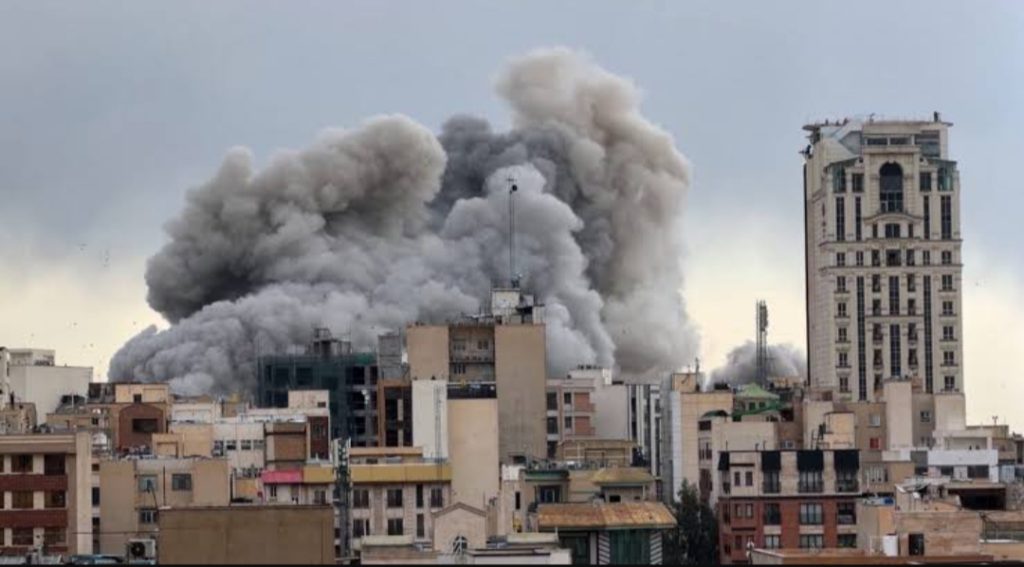
Imagine the difference in scale compared to ancient civilizations. When the Romans burned forests to build warships, the damage was limited to the Mediterranean region. When the Maya faced droughts caused by war, the impact shook only Mesoamerica. But in the Anthropocene. In 2022, the Russia-Ukraine war cut off wheat supplies to Africa, triggering famine in innocent nations, while emissions from tanks and drones accelerated global warming. The Israel-Palestine conflict is not merely a territorial dispute; explosions in Gaza produce debris that contaminates groundwater for generations, exacerbating the water crisis in an already arid region. Currently, the latest war between the U.S.-Israel alliance against Iran is not only causing oil prices to skyrocket, but also disrupting the supply of fertilizers, raw materials for chip production, and plastics, while the scenario of nuclear weapon use feels increasingly real. The consequences of this war extend not only to the global order and power dynamics but also to the potential annihilation of human populations and widespread destruction. The US and Israel have escalated the scale of destruction to a new level by provoking Iran.
What sets the Anthropocene apart is the butterfly effect on a planetary scale. Modern technology amplifies the impact of conflicts; satellites enable cross-continental precision strikes; global supply chains make economic sanctions felt in every supermarket; and nuclear weapons threaten a “nuclear winter” that could destroy global agriculture. Data from the Peace Research Institute Oslo shows that the escalation of interstate conflict in 2022 reached a record high not because there were more wars, but because each war now results in far greater casualties and destruction.
Moreover, the Anthropocene reveals a two-way relationship between humans and the planet. War damages the environment phosphorus bombs scorch the land, oil spills from warships pollute the seas but a damaged environment also triggers new wars. The struggle for water in the Nile River, resource conflicts in the melting Arctic, or climate migration in Bangladesh all of these are seeds of conflict sown by carbon emissions from past wars. Paul Crutzen, who coined the term “Anthropocene,” warns that we have entered an epoch in which humans are a “geological force,” and that force is now moving in its own direction.
In essence, the Anthropocene has transformed war from a local tragedy into an existential threat. Previous civilizations collapsed because wars exceeded their capacity; we risk collapse because our wars exceed the planet’s own capacity. This is no longer about winning or losing it is about survival.
3. Modern Warfare and Escalating Destruction
Modern warfare no longer resembles the chivalric battles of Roman times or the ritual wars of the Maya cities. In the Anthropocene era, conflict has transformed into a machine of destruction supercharged by technology; the speed of information and global connectivity make escalation faster, the impact more widespread, and recovery nearly impossible.
Consider the U.S.-Israel war against Iran, which began in late February 2026 and continued through April 2026. Gulf states such as the UAE, Kuwait, and Bahrain, along with claims of Iran shooting down U.S. F-35s, disrupted oil shipments through the Strait of Hormuz (accounting for about 20% of global supply), leading to a surge in global oil prices and energy inflation that triggered recession risks in the U.S., Europe, and Asia.
Furthermore, the 2022 Russia-Ukraine war demonstrated how modern technology accelerates and amplifies the impact of war. Starlink facilitated coordination on the battlefield. This conflict was also marked by long-range missile strikes, cyberattacks, and information warfare unfolding at breakneck speed in the digital realm. The global impact is also evident. Modern technology can exacerbate climate pressures, though comparisons of a country’s annual emissions must be supported by clear, specific data. The pattern is clear: technology does not make war “clean,” however rather accelerates destruction and expands the number of innocent victims. Like ancient civilizations, we build fragile systems but this time, the system is the entire planet.
4. The Link Between War, Ecology, and Inequality
War never stands alone; it is always a node in a broader network of crises. In the Anthropocene era, the connection between war, ecological destruction, and structural inequality has become increasingly clear and deadly, creating a vicious cycle in which one crisis fuels another.
First, war often arises from greed and the struggle over resources whether scarce or not whether consciously or not. When Iranian drones attacked energy infrastructure in Gulf nations such as the UAE, Kuwait, and Bahrain, the global energy market was shaken by rising oil prices and energy inflation, exacerbating the risk of recession in the United States, Europe, and Asia. Resources are no longer merely a “war bonus,” but a triggering factor that exacerbates global geopolitical tensions.
Second, conflicts such as the U.S.-Israel-Iran conflict since February 2026 have caused disruptions to energy infrastructure in the Persian Gulf, which has the potential to increase carbon emissions through fires and local pollution. Institutions such as the Peace Research Institute Oslo note that modern conflicts tend to accelerate ecosystem degradation compared to past wars, although the exact scale remains a subject of research.
Third, global inequality has made the war even more brutal. Wealthy nations like the U.S. and Israel possess F-35s and Iron Dome systems, while Iran relied on its outdated drones at the start of the war. When viewed objectively, the conflict is highly lopsided, pitting a superpower like the United States against a developing nation that has endured nearly 50 years of embargoes and isolation. Amid this disparity, Iran has demonstrated that a Global South nation can fight back with the asymmetric innovation of cheap yet effective drones while developing the latest weapons. Western technology was once believed to be superior in precision strikes, but Iran’s resilience in a protracted war has shifted the current dynamics. Current facts reveal many long-standing shifts and imbalances, and as of the publication of this article, there is no clear end in sight to the U.S.-Israel war against Iran, nor is there clarity regarding the future of the global economy. This is not a matter of who is stronger than whom, but rather the direction of achievements and the failures of global leadership that are pushing humanity a little closer to extinction.
In essence, war in the Anthropocene is not an isolated tragedy; it is a manifestation of a planet that is overburdened. Just as the Romans cut down forests for war, we are burning our future for temporary victories. The difference is that our destruction is global and irreversible
5. Rethinking Diplomacy for a Fragile Planet
If war in the Anthropocene shows that destruction is now global in nature, then diplomacy must also change. Diplomacy can no longer be understood merely as a tool to stop the shooting or sign a ceasefire; it must become an instrument to prevent the collapse of civilization itself.
The problem is, many diplomatic practices remain trapped in an outdated logic where nations negotiate only when their strategic interests are threatened, not when the planet is heading toward a tipping point. As a result, diplomacy often arrives too late. It becomes active only after millions have been displaced, after farmland has been destroyed, after war emissions have exacerbated climate change, and after inequalities have deepened. In a world as fragile as ours today, even the slightest delay can mean irreparable loss.
Therefore, diplomacy must be viewed as a preventive strategy. This means diplomacy must engage early on in issues related to natural resources, food security, climate change, military technology, and global inequality. Peace cannot be separated from ecology. There can be no long-term stability if clean water is scarce, the land is degraded, populations are forced to migrate, and nations continue to treat the environment as a collateral casualty of war.
This is where the concept of anthrodiplomacy becomes crucial. Diplomacy in the Anthropocene era must go beyond inter-state negotiations and begin to consider humanity’s relationship with the Earth that sustains their lives. It must be able to bridge security, the environment, and social justice within a single framework. In other words, the diplomacy of the future must not only ask, “How can war be stopped?” but also, “How can collapse be prevented before it begins?”
Conclusion: A Choice Between Repetition and Renewal
History does not lie. The Roman, Maya, and Aztec civilizations all reached the pinnacle of their glory before collapsing under the weight of uncontrollable wars, a devastated environment, and systems too fragile to survive. Now, in the Anthropocene, we stand at the same crossroads, only with far higher stakes: it is not a single region or a single culture that is threatened, but the entire planet and the future of the human species.
We have conscious choice. We can repeat the old patterns, believing that technology will save us, that wars can be won without consequences, that material progress automatically brings moral progress. Or we can choose a new path anthrodiplomacy which views peace not as a lull between conflicts, but as a conscious commitment to maintaining a balance between human power and the Earth’s limits.
Posted in Anthropocene

From a line drawn in 1914 to a standoff at Taksing in 2026, the eastern…