Diplomacy
Arunachal’s Restless Frontier: Why the India-China Border Is Heating Up Again
By Sameer Hussain |
From a line drawn in 1914 to a standoff at Taksing in 2026, the eastern…




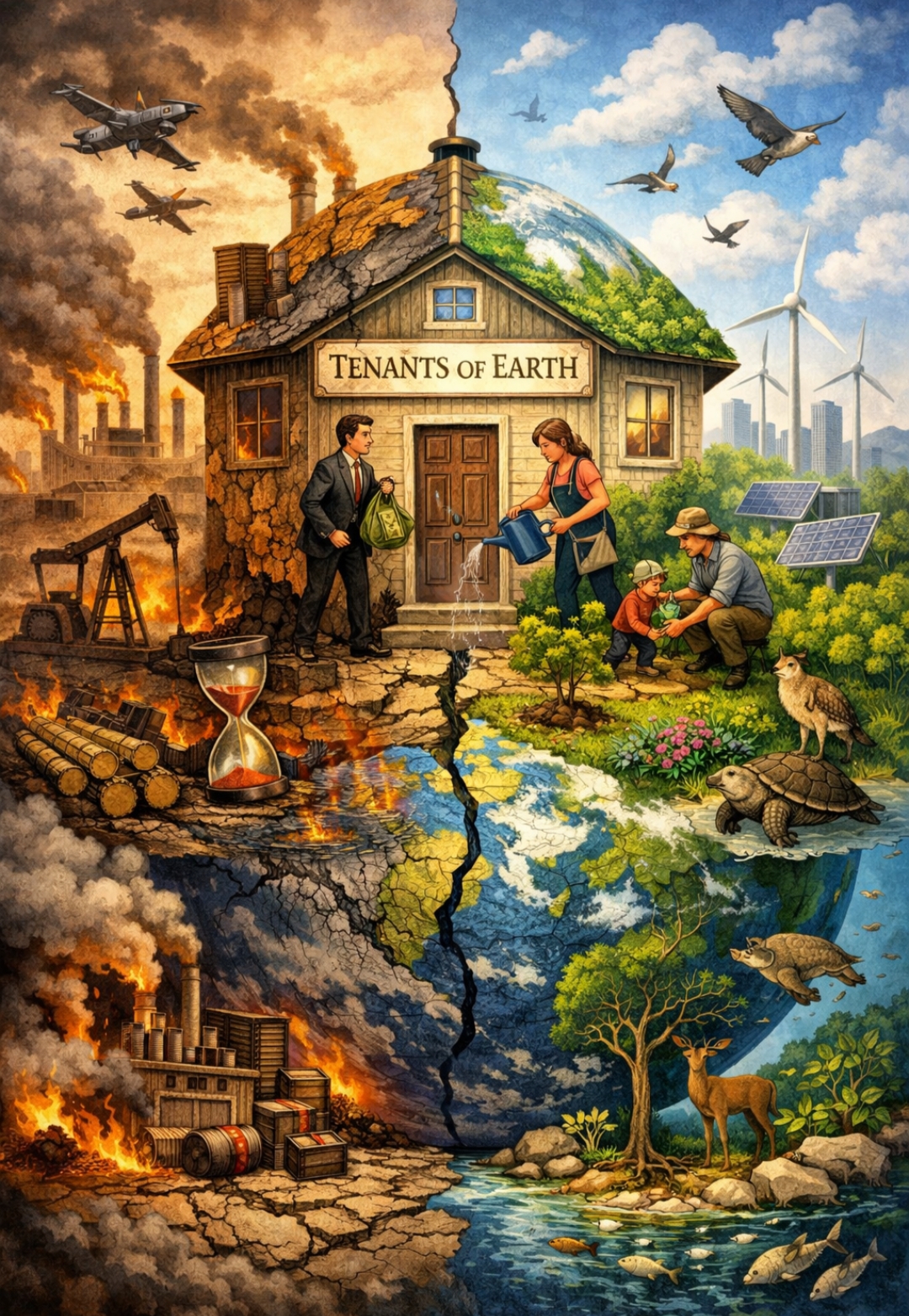
For the past few decades, humans have believed that the Earth they inhabit belongs to them. What if that belief were to crumble? What if humans were merely tenants of the Earth, not its owners?
For most of modern history, Earth has been treated as a stage that never goes off-color. Earth is a resource to be exploited, a place to build cities, drill for oil, and clear forests, but it has rarely been the subject of policy rather, it has been merely a silent object following human desires. However, in recent decades, this anthropocentric approach has begun to crack. The Earth, which we once dismissed as mere backdrop, is now revealing itself as a crucial actor shaping our future.
One seminal study that opened the eyes of many scientists was the concept of “planetary boundaries” by Rockström and colleagues in 2009. They demonstrated that Earth’s systems such as the climate, the biosphere, the water and nitrogen cycles, land use, and others operate within specific boundaries, and if humans exceed these limits, the systems could undergo major, nearly irreversible changes. In their initial study, at least 3–4 boundaries had already been exceeded, and many recent reports now indicate that the number of exceeded boundaries has increased, particularly regarding climate change and biodiversity loss.
In other words, the Earth is no longer merely a place where wars are fought; it has become a space that shapes how wars unfold, economies function, and humans survive. Floods devastating port cities, landslides upstream, droughts on farmland, and forest fire smoke blanketing cities are no longer “coincidental events.” They are signs that the system we have been disrupting for hundreds of years is now responding clearly. Energy, military, and trade policies crafted on the assumption that the Earth will always be hospitable and unchanging are beginning to show their failures.
For the first time in human history, we realize that the Earth is not merely a stage, it is an actor with limits, cycles, and the capacity to retaliate if constantly pressured.
Humans Are Not Owners, But Tenants
For centuries, human civilization has been built on the arrogant assumption that the Earth belongs to humans, and that we can therefore benefit from it, exploit it, shape it, and rule it as we please. Every trace of altered landscapes, diverted rivers, cleared forests, and mined mountains, we regard as a sign of progress, not as mounting ecological scars. Yet, history and science reveal that humans arrived late in Earth’s story, and should we eventually depart, the Earth will not crumble along with us.
Geology and paleontology teach us one crucial fact: the Earth we inhabit is approximately 4.5 billion years old, whereas the genus Homo emerged only about 2 million years ago. For most of its history, the Earth has turned without humans, and in many possible future scenarios including extreme climate change or mass extinction the Earth will continue to turn even if humanity vanishes. This is a humbling lesson, yet it also reminds us that humans are not the center of the universe, but rather a small part of a larger web of life.
In modern economic logic, the Earth is often treated as an unlimited asset owned by humans, when in fact it resembles a “large house” that all living beings share. We can build cities, drill wells, establish industries, and use resources, but we must remember that if we abuse the owner’s property, the contract will be terminated. In scientific terms, numerous studies on planetary boundaries and ecosystems indicate that when human pressure on the climate, biodiversity, and biogeochemical cycles exceeds certain thresholds, the system may undergo nonlinear changes that are difficult to reverse. The Earth will not “get angry” in a metaphorical sense, but it will shift into a new state that may no longer be hospitable to human civilization.
In this context, the phrase “humans are merely tenants on Earth” is not merely poetry, but an urgent ecological awareness. We can lease this space for a few generations, but not forever and certainly not on the condition of recklessly destroying it. If we wish to survive, we must live as responsible tenants: preserving the foundation, not damaging the walls, and not disregarding the rights of other inhabitants from soil microorganisms to the marine and forest ecosystems that sustain life.
War, Technology, and Energy: When Victory Becomes Defeat
Unfortunately, some people take great pleasure in wreaking havoc on the Earth. The most immediate example of this is war. War is no longer merely a conflict between humans. War is a battle between energy, technology, and the Earth. In every modern war, there is an invisible yet very real energy network. Oil fields, gas supply lines, critical mines, electrical infrastructure, ports, and transportation routes enable wars to proceed, weapons to be fired, and combat equipment to move. Conventional wars and modern conflict and wars such as energy wars turn the Earth into a “machine” that must continuously spew out energy and resources to sustain power.
Fossil fuels like oil, gas, and coal are not merely fuel; they form the backbone of the military-industrial complex, strategic transportation, and logistical infrastructure. Studies on energy geopolitics and warfare reveal that many conflicts of the 20th and 21st centuries stem from the struggle over energy sources and supply routes. We refer to war as a symbol of national power, yet behind it lies a struggle for energy that justifies deforestation, land destruction, and air and water pollution in conflict zones and their surroundings. The US-Israel versus Iran and Russia-Ukraine conflicts are very difficult to separate from mere territorial boundaries, sovereignty, and also energy and resources.
Meanwhile, advanced technologies such as drones, precision weapons, digital communication networks, and even nuclear weapons do indeed create an illusion of power. But all of these require vast amounts of energy, electronic components that depend on critical minerals, and infrastructure that is both vulnerable and invasive. While military technology is impressive on the one hand, on the other it is a never-ending consumer of energy and a source of exploitation. Its legacy is not merely explosions and rubble, but also soil contamination, polluted freshwater, and chemical or radioactive waste that persists far beyond the duration of the war itself.
In this context, war rarely brings a truly holistic victory. Victory on the battlefield can mean the destruction of ecosystems, the collapse of local economies, and the displacement of hundreds of thousands of people. Meanwhile, on a planetary scale, war serves as an additional trigger for global warming and habitat destruction that accelerates species extinction. We may win one war, but the Earth and future generations could lose far more.
In the Anthropocene era, we need to rethink our notions of “power” and “victory”: that true power does not lie in the ability to destroy, but in the ability to sustain life, respect the Earth’s limits, and put an end to destructive energy and mineral exploitation. Thus, victory is no longer measured by how much we can destroy, but by how much we can protect and nurture for the future.
Sharing with the Earth and Other Living Beings: Is It Possible?
To this day, humans often treat the Earth as an endless business opportunity, extracting, exploiting, and altering the landscape in the name of economic growth and military projects, without considering what is lost in the process such as biodiversity, ecosystem stability, and the right of other living beings to exist. However, history shows that when a system begins to show signs of damage as wildfires, massive floods, and species extinctions the balance is no longer stable.
In her book “The Arrogant Ape”, Christine Webb argues that our earliest science education reinforces the idea that nature is something to be used and manipulated, as long as it serves human knowledge and progress. This anthropocentric view has indeed long been embraced by humanity.
Planetary thinking calls on us to build a life of shared existence with all living beings and Earth’s systems. It is not only humans who feel the impact of exploitation; flora, fauna, and other ecosystems also suffer. Sustainable energy and military policies must take into account the needs and rights of all these beings, and build systems that support sustainability and social justice. To build a life shared with the Earth, humans need to:
In this way, humans will become “wise tenants” living in harmony with the Earth and all other beings, rather than greedy tenants who violate this contract. We all have the choice to live as wise tenants or as greedy tenants. Who is willing to do this, and where should we start?
Syarifah Huswatun Miswar (孙美琳) from Indonesia. She received a Master of Law in International Relations from the School of International and Public Affairs, Jilin University, China. She is a research analyst with an emphasis on Environmental in International Relations issues. Now she is doing her doctoral degree in Central China Normal University (CCNU) in International Relations.
Posted in Anthropocene

From a line drawn in 1914 to a standoff at Taksing in 2026, the eastern…