Diplomacy
Arunachal’s Restless Frontier: Why the India-China Border Is Heating Up Again
By Sameer Hussain |
From a line drawn in 1914 to a standoff at Taksing in 2026, the eastern…




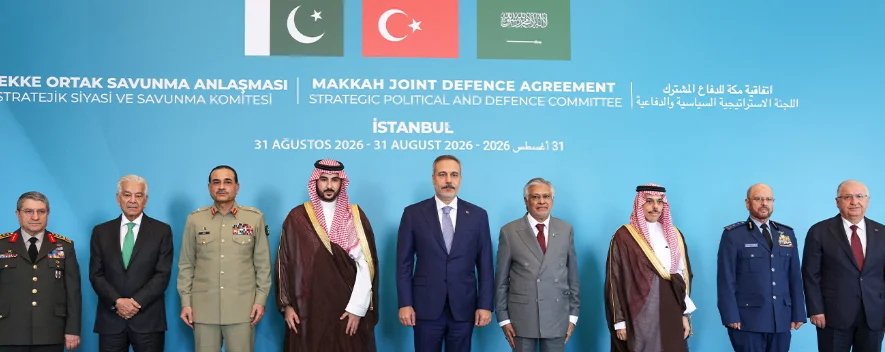
For seven decades, Pakistan has described itself as a founding member of the Non-Aligned Movement — a state that, in principle, refuses to bind its security to any single bloc. That posture was never entirely accurate in practice, given Islamabad’s Cold War-era alliances with Washington. But on 7 August 2026, in the holy city of Makkah, Pakistan formally closed the door on any pretense of strategic neutrality. Standing alongside Saudi Crown Prince Mohammed bin Salman and Turkish President Recep Tayyip Erdoğan, Prime Minister Shehbaz Sharif signed the Makkah Joint Defence Agreement — a trilateral pact committing the three states to treat an armed attack on any one of them as an attack on all. Pakistan is no longer merely non-aligned. It is multi-aligned.
The Makkah accord did not emerge from nowhere. It followed the Strategic Mutual Defence Agreement between Pakistan and Saudi Arabia that was signed in Riyadh in September 2025, which is a formalization of decades of covert military cooperation between the two countries. The bilateral deal was already yielding results for Islamabad as the Saudi cash infusion of $3 billion in April 2026 had helped boost the foreign exchange reserves of Pakistan. But it was scale and formality that was altered in August, with a bilateral hedge replaced by a trilateral treaty and Pakistan becoming more closely aligned with Saudi Arabia’s energy wealth and TüRKIYE’s defence industrial base, NATO’s second largest military.
This isn’t a coincidence. The agreement reflects a reorientation that has been underway since the Hamas attacks on October 2023, which is the reason for the three signatories becoming more united against Israeli and Iranian actions that are causing them alarm. The summit was given its urgency by Saudi Arabia’s vulnerability to Iranian drone attacks in the wake of the 2026 Iran war, even though the other countries were not as directly targeted as the Saudis.
For Pakistan, the appeal is straightforward. Islamabad also receives a formal deterrence pledge from two regional powers, a flow of Saudi money and a military technology route from Turkey, without a corresponding boost to its economy. But the officials have been careful to present the pact not as a confrontation but as a defensive measure. Foreign Minister Ishaq Dar said the agreement was purely defensive in nature and open to other states who desired to settle their disputes peacefully and added that the agreement doesn’t take precedence over Pakistan’s other bilateral and multi-lateral commitments.
The latter is important for the non-alignment issue. Pakistan has never withdrawn from NAM and will not withdraw from NAM. The Makkah accord, however, has concretised the trend of a foreign policy that had already been veering toward a selective, interest-based approach – with China on infrastructure and manufacture of defence items, with the Gulf on capital and labour markets, and now with Ankara and Riyadh in the field of collective security. This is indeed multi-alignment in action – not being tied to a single bloc or to none.
The harder question is whether the pact will do what it says. History has not been kind; neither the Arab League Joint Defence and Economic Co-operation Treaty (1950) nor the GCC Joint Defence Agreement (2000) has resulted in any collective action when tested. Symbolic solidarity — and the signing of the accord was packed with it, with Islamabad and Saudi cities’ landmarks lit in the three flags’ colours — doesn’t equate with the readiness to operate.
An entanglement hazard that is peculiar to Pakistan also exists. A mutual defence pact with Saudi Arabia and Turkey could in another scenario, such as a crisis in the Gulf or Eastern Mediterranean, transform Islamabad into a mutual defence commitment it does not want to be in and cannot easily tailor. A mutual defence pact with Saudi Arabia and Turkey could in another scenario, such as another crisis in the Gulf or Eastern Mediterranean, turn Islamabad into a mutual defence pact Islamabad doesn’t want to be in or can’t easily tailor. This would mean that Pakistan’s security establishment—which is already carrying a heavy burden of the resurgence of the TTP in the vicinity of Pakistan’s borders with Afghanistan—could evaluate any external deployment commitment against a heavy internal counter-terrorism burden.
The deal predictably has made New Delhi uncomfortable as a neighbour has formalized security partnership with two capable regional militaries, all armed with nuclear weapons. The future of the Makkah accord depends on how India rebalances, and whether the “open to others” language Dar floated attracts further signatories like Egypt, already connected via the existing R-4 consultative process, or will be more of a symbolic than a security arrangement like its predecessors.
Pakistan has viewed the accord as not the rejection of the ideals of ‘Non-alignment’ but the recognition of its Failure and a region where each neighbour is doing ‘hedging’. What Islamabad’s foreign policy establishment now needs to figure out is not if multi-alignment was a good idea, but how to balance the various forces of the partnerships it just strengthened.
Posted in South Asia

From a line drawn in 1914 to a standoff at Taksing in 2026, the eastern…