Diplomacy
Arunachal’s Restless Frontier: Why the India-China Border Is Heating Up Again
By Sameer Hussain |
From a line drawn in 1914 to a standoff at Taksing in 2026, the eastern…




Why Bangladesh and Asia May Matter Most
The events in Beijing were carefully planned. Over three days, U.S. President Donald Trump and Chinese President Xi Jinping presented themselves as leaders of rival powers willing to step back from conflict and find common ground. Trump called Xi “a great leader” and said the U.S.–China relationship was the “most consequential” in the world. Xi responded by saying their “common interests” were greater than their differences. After years of tariffs, tech disputes, sanctions, and distrust, these gestures carried real weight. Financial markets reacted quickly: the yuan rose, investors welcomed the ongoing tariff truce, and world capitals saw the summit as a sign that Washington and Beijing were trying to steady their tense relationship.
Despite the show of diplomatic warmth, the reality was more complex. The summit led to some economic agreements, like talks about China buying more American goods and promises of better market access, along with renewed discussions to handle disputes. However, the results were limited. There was no major trade deal, no progress on technology restrictions or industrial policy, and no real discussion of the biggest security issues. The sensitive topic of Taiwan, which could spark direct conflict, was put aside. Both countries talked about concerns in the Middle East and the importance of keeping the Strait of Hormuz open, but they did not agree on any joint action. In the end, the summit did not create a new partnership, but instead offered a temporary pause in tensions, based more on shared vulnerability than real trust.
For countries like Bangladesh, however, even a fragile U.S.–China thaw carries enormous consequences. Dhaka now finds itself navigating an increasingly complex triangle of power amid its own evolving relationship with Beijing and Washington. The recent visit of Bangladesh’s foreign minister to China, coupled with the growing significance of the U.S.–Bangladesh trade relationship, reflects the mounting pressure on smaller states to balance economic dependence, strategic autonomy, and geopolitical survival. If the Trump–Xi summit revealed anything, it is that global power politics is no longer defined solely by open confrontation, but by negotiated interdependence among rivals. For Bangladesh, this emerging order presents both opportunity and danger: the possibility of leveraging competition between great powers for development, but also the risk of gradually surrendering trade flexibility, strategic independence, and diplomatic sovereignty to forces far beyond its control.
Across Asia, many saw the summit not as a breakthrough, but as a short-term way to avoid instability. With wars in the Middle East threatening energy supplies and causing price shocks, Asian economies need stability between the U.S. and China. Southeast Asian countries, already trying to balance U.S. security support and China’s economic influence, welcomed the show of restraint. China felt reassured that its energy routes would stay safe, while the U.S. showed it was not ready to cut economic ties with Beijing. Even Europe, though skeptical of Trump’s approach, quietly approved of the ongoing tariff truce and the pause in rare-earth export limits. Still, there is deep unease. European leaders know that any temporary deal between the U.S. and China mostly helps their own companies, not Europe’s interests. Asian allies like Japan and South Korea are also unsure, worried that friendlier U.S. talk toward China could weaken American promises about Taiwan or regional security. The summit may have eased short-term tensions, but it also increased global worries that the rules for alliances, trade, and security are becoming more unpredictable and based on short-term deals.
For developing countries, the effects are even more serious. Trump’s visit to Beijing showed that globalization is now shaped by selective connections managed by big powers, not by open cooperation. Countries in Asia, Africa, and the Global South are under growing pressure to pick sides in economic, tech, and strategic matters. The talk of “strategic stability” between the U.S. and China does not remove this pressure; it often makes it more permanent. Smaller economies are expected to deal with the fallout from supply-chain changes, export limits, currency swings, and high-level bargaining they cannot control. This is why Bangladesh’s current diplomatic choices matter so much. As Dhaka builds closer ties with China and seeks more trade with the U.S., it risks becoming more dependent and losing some political freedom. Bangladesh might get short-term gains like more exports, infrastructure funding, and market access, but the bigger risk is losing strategic independence as its trade, security, and diplomacy become linked to the demands of powerful countries. In this new world, even staying neutral comes at a high cost.
Bangladesh therefore stands at the intersection of a changing global order where economic opportunity and geopolitical pressure increasingly arrive together. The Trump–Xi summit demonstrated that even amid rivalry, the world’s major powers remain deeply interconnected — capable of pausing confrontation when mutual intereBangladesh now finds itself at a crossroads, where economic opportunities and geopolitical pressures come together. The Trump–Xi summit showed that even when rivals, the world’s biggest powers are still closely connected. They can pause conflicts when it suits them, but they are not ready to solve their deeper disagreements. For Dhaka, this means both new chances and new risks. China offers funding for infrastructure, political support, and long-term business partnerships. The U.S. provides key export markets, financial power, and access to global institutions. But neither partnership is neutral. China expects support on issues like Taiwan and regional strategy, while the U.S. increasingly ties trade to rules on regulation, labor, digital policy, and possibly security. The real risk for Bangladesh is not being taken over by one side, but slowly losing its ability to make independent decisions as it becomes more tied to both powers.nce, institutional capacity, and diversified partnerships. Dhaka must avoid becoming merely a peripheral arena where larger powers negotiate influence. Instead, it should leverage competition between Washington and Beijing to strengthen its own bargaining position. That means accepting Chinese investment without surrendering strategic leverage, implementing trade reforms demanded by the United States without allowing domestic industries and labor markets to become excessively vulnerable, and simultaneously deepening engagement with regional actors such as India, Japan, and the European Union. Bangladesh’s future stability will depend not on choosing a camp, but on preserving enough autonomy to maneuver between competing camps.
In the next few years, Bangladesh will find out whether it can become a confident middle power in the Bay of Bengal or if it will be limited by outside pressures. The best outcome would be more diverse trade, balanced diplomacy, better infrastructure, higher exports, and greater importance in world affairs. But there is also a real risk: trade deals could limit Bangladesh’s own policy choices, dependence on others could reduce its diplomatic freedom, and regional problems could force Dhaka into tough decisions it has tried to avoid. Trump’s visit to Beijing showed that while big powers can agree on short-term stability, smaller countries have to deal with the results. Bangladesh’s real challenge is not just to get by in this new world, but to find its own place and shape its future.
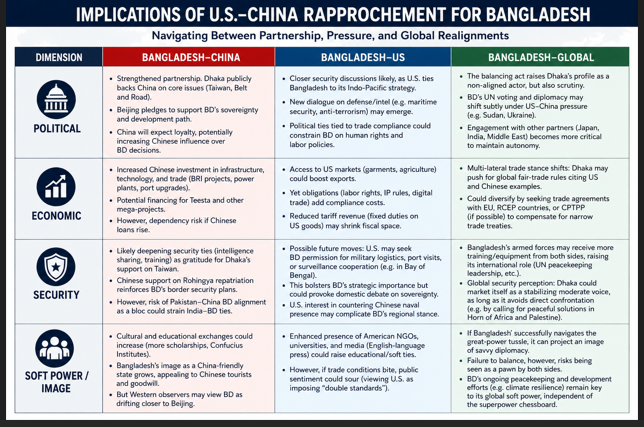
Figure 1 illustrates the multidimensional implications of the evolving U.S.–China dynamic for Bangladesh by mapping its potential effects across four critical domains: politics, economy, security, and soft power. The framework highlights how Bangladesh’s deepening engagement with China, expanding trade relations with the United States, and broader global positioning create both opportunities and constraints. It demonstrates that Dhaka’s future foreign policy challenge will not simply be balancing two major powers, but preserving strategic autonomy while leveraging economic partnerships and maintaining its role within an increasingly fragmented global order.
Ultimately, Bangladesh’s future will depend not on choosing between Washington and Beijing, but on preserving the strategic flexibility to engage both without becoming dependent on either. In a world increasingly shaped by great-power bargaining and selective interdependence, Bangladesh’s greatest strength may lie in its ability to remain balanced, adaptive, and sovereign while transforming geopolitical competition into national opportunity.
Posted in Uncategorized

From a line drawn in 1914 to a standoff at Taksing in 2026, the eastern…