Diplomacy
Arunachal’s Restless Frontier: Why the India-China Border Is Heating Up Again
By Sameer Hussain |
From a line drawn in 1914 to a standoff at Taksing in 2026, the eastern…




Guest 2: Bangladesh
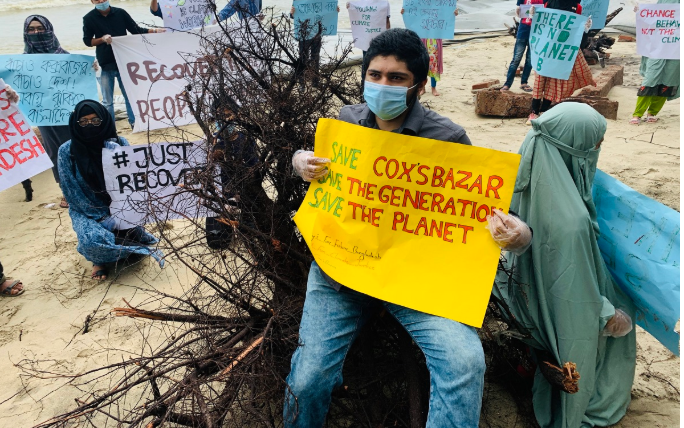
Bangladesh is one of the most vulnerable countries to climate change, despite its contribution to emissions being negligible compared to developed countries. In this context, Bangladesh is often held up as a classic example of climate injustice: those who contribute the least to emissions are the ones who bear the brunt of the impacts.
On this occasion, we again welcome a guest for the second session: Mr. Md. Toufik Ahmed, a UGC PhD Fellow at the Institute of Bangladesh Studies, University of Rajshahi. He views the Anthropocene not merely as an academic concept but as an ongoing reality. In his view, the Anthropocene refers to an era in which human activity has become a major force shaping the Earth’s systems, from climate change to ecosystem degradation.
For Bangladesh, this concept holds profound relevance. The country contributes only about 0.4% of global greenhouse gas emissions, yet faces profound impacts: increasingly intense flooding, more destructive cyclones, sea level rise, and erratic rainfall patterns. Toufik emphasized that these phenomena cannot be understood as isolated natural events, but rather as consequences of human activity on a global scale, particularly in industrialized countries in the Global North.
Natural Disaster or Global Injustice?
In explaining the climate crisis in Bangladesh, Toufik firmly rejects the narrative that simplifies it as a mere natural disaster. While floods and cyclones have a natural dimension, the deeper roots of the problem are structural and global. He said:
“From a Bangladeshi perspective, I would say this crisis is best understood as a global structural injustice. Yes, floods and cyclones are natural events, and yes, governance challenges exist. But the root cause lies beyond Bangladesh. The country did not create the climate crisis. Yet, it is paying a disproportionate price. So, ethically and politically, this is not just an environmental issue-it is a question of justice, responsibility, and fairness in the global system.”
He sees this crisis as a manifest form of global injustice. Bangladesh did not create the climate crisis, but has had to bear its disproportionate impacts. Thus, this issue is not only environmental, but also concerns responsibility, ethics, and the distribution of power in the international system. In the context of the Anthropocene, the key question is not just about environmental change, but about who causes it and who should bear the consequences.
Emergency Portraits: River Erosion & Forced Migration
One of the most concrete manifestations of this crisis is riverbank erosion, which Toufik describes as a form of “slow violence.” Unlike sudden disasters, this erosion is gradual but devastating. Villages can disappear overnight, houses collapse into rivers, and families are left homeless without adequate protection.
The impact goes beyond physical loss. This erosion triggers long-term social and economic instability, pushing communities to forced displacement. In this context, the internal migration experienced by millions of Bangladeshis is often understood as a form of adaptation. However, Toufik offers a more critical perspective.
He argues that while migration can reflect resilience, in many cases in Bangladesh, it is better understood as a humanitarian crisis. This displacement is involuntary and occurs due to a lack of other options. When millions of people are forced to leave their homes without adequate planning and protection, it is not simply a survival strategy but a form of distress-driven displacement.
Obstructed Policy: Delta Plan 2100
At the policy level, Bangladesh demonstrates a long-term commitment through the Bangladesh Delta Plan 2100. This document reflects an ambitious vision to manage environmental challenges in an integrated manner, particularly in water and land management.
However, its implementation faces various obstacles. Toufik highlighted overlapping authority between agencies, a lack of institutional coordination, and corrupt practices that remain challenges.
He further explained that
“Bangladesh has been playing an active role in managing the climate crisis. Policies like the Bangladesh Delta Plan 2100 show long-term vision and ambition. From my research, one of the most difficult areas is coordinated, long-term land and water management under the plan. The challenge isn’t just technical-it’s institutional. There are issues like overlapping authorities, a lack of coordination, and sometimes corruption. Also, political systems tend to prioritize short-term, visible projects over long-term resilience planning, which makes implementation even harder.”
Furthermore, political systems tend to prioritize short-term projects with quickly visible results over long-term investments in environmental resilience. This combination of factors makes conceptually sound policies difficult to implement effectively.
Mitigation vs. Adaptation: Bangladesh’s Realistic Choice
In the debate between mitigation and adaptation, Toufik acknowledged that mitigation is crucial but difficult to rely on in the short term. Emission reduction efforts rely on complex international cooperation and are often hampered by divergent national interests.
In this context, adaptation is a more realistic option for Bangladesh. Besides being more contextual, it also provides immediate benefits to communities already facing the impacts of the crisis. However, this approach does not address the root causes of global problems, which remain beyond the control of countries like Bangladesh.
Climate Justice & Demands from the Global South
This situation reinforces the urgency of climate justice. Toufik argues that countries in the Global South, including Bangladesh, need to take a more assertive stance in international forums. Demands for climate finance, compensation for loss and damage, and technology transfer are not acts of charity, but rather obligations rooted in the historical responsibilities of developed countries.
In other words, climate justice must be understood as part of global political negotiations, not merely a moral discourse.
Reflections of a Young Researcher & Hope
Beyond policy analysis, Toufik also reflects on the challenges of being a doctoral researcher in Bangladesh. Limited funding, data access, and barriers to international publication are part of the realities faced by researchers in developing countries. Nevertheless, he emphasizes that the motivation to research remains strong because the issues raised are not distant but rather everyday experiences.

He also sees the important role of institutions like the Institute of Bangladesh Studies in shaping public discourse and knowledge. However, there remains a gap between research results and policy implementation, which needs to be bridged for research to have a real impact. If given the opportunity to speak at a global forum like the COP, her message would be simple yet unequivocal: commitment to climate justice must be realized now, not postponed. Meanwhile, for the younger generation, he emphasized that research is not just about producing knowledge, but also a tool for change. Connecting research to social realities, policies, and global dynamics is a crucial step in addressing the climate crisis in the Anthropocene era.
Posted in Anthropocene, Diplomacy

From a line drawn in 1914 to a standoff at Taksing in 2026, the eastern…