Diplomacy
Arunachal’s Restless Frontier: Why the India-China Border Is Heating Up Again
By Sameer Hussain |
From a line drawn in 1914 to a standoff at Taksing in 2026, the eastern…




Author: Edward Fishman
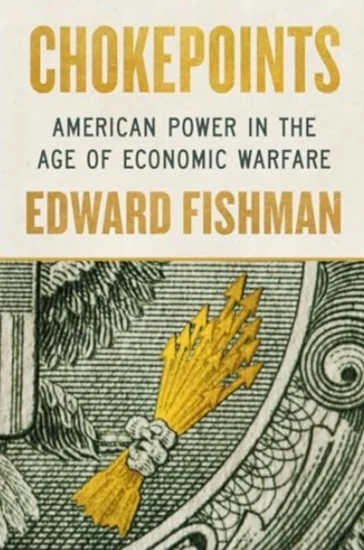
The book Chokepoints: American Power in the Age of Economic Warfare is a study of how the US learned to use its economic leverage against its adversaries and friends in the mid-2000s. It is written by Edward Fishman, who is a former US diplomat specialising in economic sanctions. The book demonstrates that the US has converted its position in critical financial, technological, and energy networks into strategic leverage. This leverage has been used against its adversaries and, increasingly, its allies and foreign companies. Economic interdependence, therefore, is not merely a source of mutual gains; it can also become a source of coercive power.
The book uses a historical case-study approach to examine the development and application of economic warfare. Since the author is a former US Department official, he extensively uses primary sources, i.e., government policies, legislative measures, sanctions records, and interviews and recollections of the US officials involved in their design and implementation. He also uses economic data and secondary sources to assess the effects of these measures. Detailed case studies of Iran, Russia, China, and other cases allow him to connect policy decisions with their economic and strategic consequences.
Fishman’s central concern is the transformation of economic interdependence into a source of coercive power. Traditionally, economic sanctions were often slow and difficult to enforce, and their ability to produce political concessions was uncertain. After 9/11, however, the US developed a more effective form of economic warfare by exploiting its control over critical financial chokepoints. This allowed Washington to pressure not only its adversaries but also foreign banks and companies that continued to do business with them. Against this background, Fishman examines how the US acquired and developed this economic power and how it has used it against major adversaries.
He first establishes that American economic power is the product of a much longer historical evolution rather than a recent policy innovation. He traces the history of economic warfare back to Pericles’ embargo on Megara in 432 BC. He uses examples of Napoleon’s Continental System, the League of Nations, and UN sanctions on Iraq to demonstrate the use of economic warfare in history. He then explains that the post-war expansion of the dollar, financial liberalisation, and the development of critical infrastructure, such as SWIFT, enabled the US to control and weaponise the global financial system. These developments placed the US at critical points within the global financial system, allowing Washington to transform economic interdependence into strategic leverage.
His analysis of US use of economic warfare against Iran and Russia demonstrates both the growing sophistication and the limitations of this form of economic coercion. In the case of Iran, the US used secondary sanctions to pressure foreign banks to cut their ties with Iran. After restricting foreign banks, the US targeted the central bank and oil revenues to cut Iranian oil exports. Owing to these sanctions, Iran’s sales of 2.5 million barrels per day were reduced to 1 million barrels per day within 18 months. It contributed to severe economic pressure and helped create the conditions for the 2015 nuclear agreement. The US used similar strategies against Russia; however, the Russian case illustrates the limits of sanctions when they are imposed on a larger economy. For example, Germany defended Nord Stream 2, and Siemens and European states were reluctant to impose further costs on Russia. Thus, he shows that economic warfare can impose substantial economic costs, but its political effectiveness depends heavily on the target state’s vulnerabilities, available alternatives, and capacity to adapt.
Fishman argues that the nature of economic chokepoints is also changing. Technology has increasingly emerged as a new source of strategic leverage. The US-China trade wars demonstrate this. Trump administration combined tariffs with tighter restrictions on Chinese investment and access to sensitive technologies. It used tariffs and strengthened the Committee on Foreign Investment in the United States (CFIUS) to restrict Chinese investment in sensitive US technologies. He explains the case studies of Chinese corporations such as ZTE, Fujian Jinhua, and Huawei to demonstrate how technological dependence can be transformed into economic leverage. At the same time, Fishman acknowledges that this imposes costs on US companies, highlighting concerns about the economic consequences of weaponising technological interdependence.
The author also notes that the US has evolved its economic warfare strategies in response to changing circumstances and targeted states. One such example was the innovation of capping Russia’s oil prices to force Russian oil to be sold below market price. The US and its allies sought to constrain Russian oil revenues while keeping Russian oil in global markets by exploiting the G7’s influence over shipping, insurance, and financial services. The scale of these measures demonstrates the extraordinary reach of US-led economic warfare. Still, it also raises questions about how long such leverage can remain effective when targeted states develop alternative financial, technological, and commercial networks.
The author not only examines the strategies of economic warfare but also highlights the risks associated with repeatedly weaponising economic interdependence. The US’s use of economic warfare or control over the global financial system has led to ruptures in the global economic order. It has encouraged states to reduce their dependence on strategic rivals, which is contributing to friend-shoring, diversification, and domestic industrial policies. It is also seen in the increase of competing economic networks, with efforts such as those within BRICS to reduce exposure to Western financial powers. The paradox is that the very interdependence that gives the US its economic leverage may gradually be weakened by its repeated weaponisation. In this sense, economic warfare may ultimately undermine the global economic system that has enabled American power in the first place.
Collectively, the author explains the nature of American economic power in the era of economic interdependence. He argues that the US occupies critical positions in the global financial systems that allow it to convert interdependence into a strategic tool. Financial networks, the dollar, energy markets, shipping, stock markets, and influence in international financial institutions (IFIs) are all strategic tools it uses to achieve its objectives. He shows that the strongest weapon in the US arsenal against its adversaries is not a weapon at all. Just like military leaders modernise their armies to adapt to changing circumstances, a new class of officials, sanctions technocrats, adapted and modernised economic warfare.
The book’s main strength lies in its ability to translate the complex concept of economic warfare into clear, practical analysis. The book provides an insider’s perspective on Washington’s policymaking. The main strength of the book is its clear, vivid, and simple explanation of complex concepts in economic warfare. He demonstrates this through case studies of Iran, Russia, and China. Some chapters are only three or four pages long, which shows the clarity and conciseness of his writing. Moreover, the book offers a unique perspective by showing how complex interdependence can also be weaponised, rather than serving only as a source of cooperation and mutual gains, as emphasised by liberal theory. Overall, the book makes a valuable contribution to the literature on weaponised interdependence and economic geopolitics.
At the same time, Fishman’s strong focus on economic warfare risks overstating its independent strategic importance. For example, despite decades of US sanctions, Iran has retained its political and military capacity. In fact, the recent US-Iran war has inflicted considerable harm on US interests in the Gulf region. The conflict shows that technologically inferior states can challenge stronger adversaries through asymmetric capabilities. North Korea provides another example of the limits of economic and technological leverage in achieving broader political and military objectives. Moreover, while he emphasises the growing strategic importance of financial and technological chokepoints, natural resources, especially critical minerals, remain an important source of geopolitical leverage. Control over these resources can provide middle powers, like Pakistan, with strategic influence even without comparable financial and technological capabilities. Moreover, economic warfare often has far more humanitarian consequences than other forms of war, and the author seems less concerned with this normative dimension; instead, he focuses on efficacy and on achieving political objectives.
To conclude, the book provides a detailed account of how the US has transformed economic interdependence into a source of strategic power. It does this by showing that economic chokepoints, i.e., energy, technology and finance, can impose high costs on adversaries. The book also highlights the limits and unintended consequences of their use. It also warns that the growing search by Russia, China, and other states for alternatives is reducing their dependence on the US-dominated systems. Continued weaponisation of interdependence could therefore weaken the very global system that gives the US its economic leverage. Fishman’s analysis will be of particular interest to scholars and practitioners of international relations, especially those concerned with sanctions, economic coercion, and the future of US economic power.
Posted in Book Review

From a line drawn in 1914 to a standoff at Taksing in 2026, the eastern…