Diplomacy
Arunachal’s Restless Frontier: Why the India-China Border Is Heating Up Again
By Sameer Hussain |
From a line drawn in 1914 to a standoff at Taksing in 2026, the eastern…




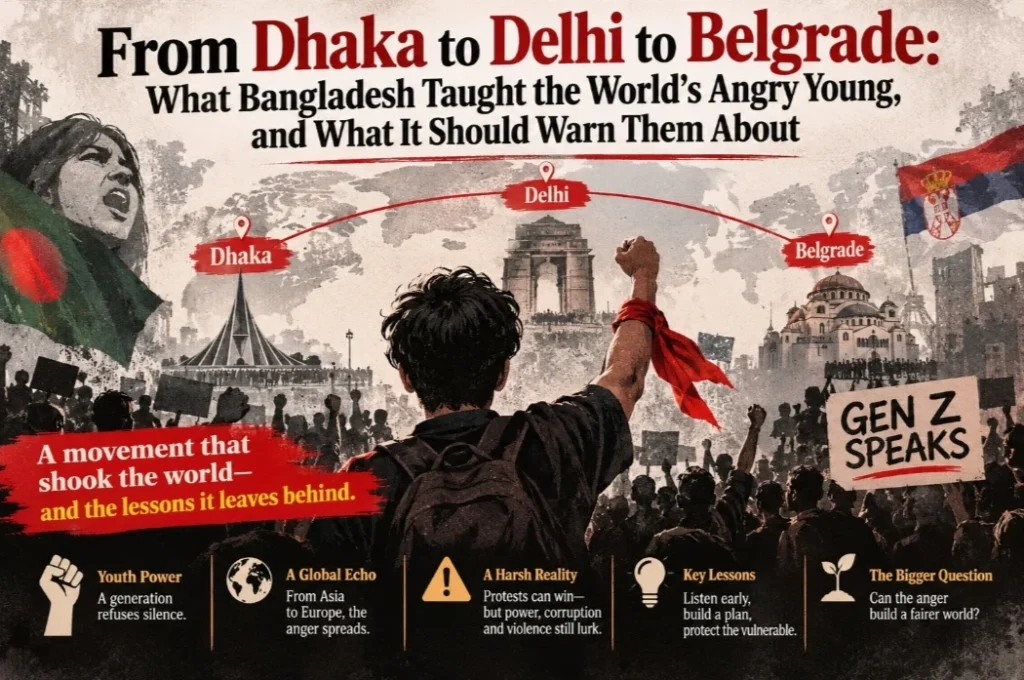
Bangladesh did not invent youth protest. But it wrote the modern script. In July 2024, students angry about a job quota turned a narrow grievance into a national revolt. Within weeks, Sheikh Hasina, in power for 15 years, fled to India. Since then, young people from Kathmandu to Sofia have tried the same play in different forms. Some have won. Others have learned that toppling a government is the easy part.
The Dhaka model had clear features. It was led by students, not parties. It was decentralized, with coordinators who could be arrested and replaced. It used social media to beat a captured press, and it survived internet shutdowns. It also paid a terrible price. A UN human rights fact-finding report, published on 12 February 2025, estimated that as many as 1,400 people may have been killed between 1 July and 15 August 2024. As many as 12 to 13 percent were children. The report found reasonable grounds to believe the violence was directed by the political leadership. That scale of sacrifice gave the movement moral force. It also made retreat impossible for both sides.
The results are real. Nobel laureate Muhammad Yunus led an interim government. Reform commissions produced the July Charter. On 12 February 2026, Bangladesh held a general election and a referendum on that charter on the same day. The BNP won 209 of the 297 seats declared, a two-thirds majority. Jamaat-e-Islami became the main opposition with 68. The student-founded National Citizen Party won just six. The charter passed with 47,225,980 votes, or 68.26 percent of valid votes, according to the Election Commission’s corrected gazette. In November 2025, an International Crimes Tribunal sentenced Hasina to death in absentia.
But the scorecard is mixed. The students who led the uprising did not inherit it. An established dynastic party did. The new government has declined to convene the Constitution Reform Council that the referendum envisaged. The opposition calls this betrayal. Mob violence surged during the transition. The rights groups counted 197 mob killings in 2025 alone. Minorities reported repeated attacks. Amnesty International called Hasina’s trial a “grave miscarriage of justice.” The Awami League was barred from the vote. None of this cancels July 2024. But it should temper the myth.
The movement’s moral standing has also suffered. Several of its leaders moved quickly into positions of power, and allegations followed. In April 2025, two officials drawn from the student ranks, an assistant private secretary to adviser Asif Mahmud and a student representative in the health adviser’s office, were removed amid claims of bribery over transfers and rigged tenders. The student-founded National Citizen Party’s joint secretary was suspended over similar charges. The Anti-Corruption Commission opened inquiries into all three. Months later, police arrested a Dhaka convener of Students Against Discrimination over an alleged attempt to extort Tk 50 lakh from a former MP’s home. The platform then suspended every committee except its central body. One of its former spokespersons said she wasn’t surprised. The accused have denied wrongdoing, and many claims remain unproven. But the pattern matters. A movement that rose against privilege now stands accused of pursuing it. That raises a hard question: were its high ideals a lasting conviction, or a moment that power was always going to test?
The myth traveled anyway. The Associated Press reported that Nepal’s protesters drew inspiration from Sri Lanka in 2022 and Bangladesh in 2024. In September 2025, a social media ban in Nepal triggered an explosion of anger at “nepo kids.” Seventy-six people died. Parliament burned. The prime minister resigned. Protesters helped choose an interim leader through a Discord vote. In March 2026, Balen Shah, a 35-year-old former rapper, led his party to 182 of 275 seats. Madagascar’s Gen Z said it was inspired by Nepal. Its president fled in October 2025, but an army colonel took power. Peru’s Congress removed its president that same month amid youth protests. Morocco’s Gen Z 212 organized on Discord. The One Piece pirate flag became a shared emblem from Jakarta to Antananarivo.
India is now the most important test. In May 2026, India’s Chief Justice compared unemployed youth to “cockroaches.” He later said he meant only people with fake degrees. A satirical Cockroach Janta Party was born online. Four days after its 16 May launch, its Instagram account had 10.9 million followers, passing the BJP’s 8.7 million, according to The Tribune; by early October it had about 25 million. Leaked medical-entrance papers gave it a cause. In July, Education Minister Dharmendra Pradhan resigned, the first such exit from Narendra Modi’s cabinet since 2014. Protests have since widened to alleged voter-roll manipulation. The government has drawn its own lesson from the neighbors. Before the Supreme Court, it argued that Ladakh activist Sonam Wangchuk wanted a “Nepal-like” or “Bangladesh-like” situation. Four people died when police fired in Leh in September 2025. Bangladesh has become both an inspiration and an exhibit for the prosecution.
Europe shows the same energy in a different shape. In Bulgaria, a tax-raising budget sparked protests in late November 2025. The government resigned on 11 December. Commentators called it the first European government toppled by Gen Z. Serbia’s students have protested for almost two years since a station canopy collapse killed 16 people in Novi Sad. They now contest a snap election on 25 October under a “Students Win” list. France’s “Bloquons tout” began as a leaderless online call to shut the country down. One Piece flags appeared there too.
Yet diffusion is easy to overstate. Serbia’s revolt began in November 2024, almost a year before Nepal’s. Bulgaria’s anger stems from its own state capture. Few European protesters cite Dhaka. They borrow the aesthetic more than the strategy. Structures differ too. Bangladesh, Nepal and Madagascar concentrated power in one capital, and their security forces eventually stopped defending the ruler. India is federal, with power spread across many cities and an elected majority in Parliament. European states have courts, regular elections, and the EU. There, the realistic route runs through the ballot box. Serbia’s students understand this. Bulgaria shows the risk: its April 2026 election was won by Rumen Radev, a former president, not by the protest generation.
What, then, truly travels? Three things. First, an economic squeeze on the young. Azim Premji University’s State of Working India 2026 report puts graduate unemployment at nearly 40 percent among Indians aged 15 to 25. Morocco’s High Commission for Planning put unemployment among 15- to 24-year-olds at 37.7 percent in the first quarter of 2025. Second, visible elite privilege, broadcast on every phone. Third, a trigger that insults dignity: a quota, a ban, a slur, a leaked exam. Tools travel as well. Discord, Instagram and memes cut the cost of organizing. But tactics do not decide outcomes. Writing on a London School of Economics blog, Duncan Green argues that movements succeed when governments are divided or vulnerable, as in Bangladesh, Nepal and Madagascar, and fail when the security sector stays unified and repressive, as in Iran and Morocco.
Governments should learn the right lesson. Repression is an accelerant, not a cure. Dhaka’s crackdown turned a quota dispute into a revolution. Nepal’s social media ban did the same. Internet shutdowns saved neither government. Listening early is cheaper than conceding late.
Movements should learn from harder ones. Leaderless protest is strong in the street and weak at the negotiating table. Bangladesh’s students won the uprising but not the election. Madagascar’s youth won a revolt and got a colonel. Movements need a program, a party or a pact before victory, not after. They must also protect minorities and reject mob justice. Otherwise they hand their opponents a ready-made story.
Bangladesh is a pilot, not a template. It proved that a generation without jobs or voice can break an entrenched regime. It has not yet proved that such a generation can build a better one. For Dhaka, the task is to make the July Charter real. For India, Europe and beyond, the lesson is plain. The anger is genuine. The outcome is not guaranteed. What happens after the crowds go home decides whether July was a revolution or only a rupture.
Posted in Security and Peace

From a line drawn in 1914 to a standoff at Taksing in 2026, the eastern…