Diplomacy
Arunachal’s Restless Frontier: Why the India-China Border Is Heating Up Again
By Sameer Hussain |
From a line drawn in 1914 to a standoff at Taksing in 2026, the eastern…




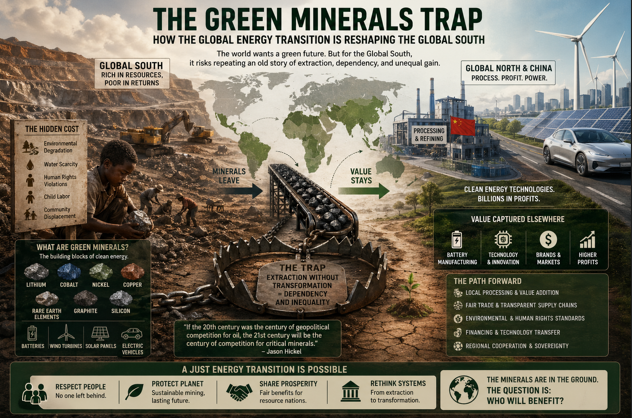
Lithium for Europe’s Electric Cars, Water for the Atacama: The Silent Price Behind Green Energy
The world is racing to go green. Solar panels are spreading across rooftops, electric vehicles are filling roads, and wind turbines are being installed across coastlines. This clean energy revolution is widely celebrated as humanity’s best hope against climate change. But beneath the surface of this optimism lies a less comfortable truth: the transition away from fossil fuels depends entirely on a new class of raw materials like as lithium, cobalt, nickel, copper, rare earth elements that are overwhelmingly found in the developing world. For nations across Africa, Latin America, and South Asia, the green transition may be promising a new future whilst quietly repeating an old story of extraction, dependency, and unequal gain.
What Are Green Minerals?
Critical minerals are the building blocks of clean energy. The United Nations defines critical energy transition minerals as those needed to build, manufacture, transport and store renewable energy such as copper, cobalt, nickel, lithium, graphite and rare earth elements needed for electric vehicles and energy storage, and silicon, cadmium and tellurium needed for solar panels. Unctad Wind turbines need neodymium and dysprosium. Lithium, nickel and cobalt are used in electric vehicle batteries. Even solar panels are built using silicon, indium and gallium. The International Energy Agency estimates that the total value of the market for key minerals for the energy transition will more than double to $770 billion by 2040. World Economic Forum a Bloomberg analysis adds that the world could need up to 3 billion metric tonnes of these metals and minerals between 2024 and 2050 to develop low carbon technologies like electric vehicles, wind farms and electrolysers. World Economic Forum The scale is extraordinary. And it puts the Global South home to most of these resources at the heart of a new and highly contested geopolitical landscape.
The Resource Paradox:
The Global South is the world’s most vulnerable region to climate change, which has done the least to cause it. Now it is expected to provide the raw materials for a green future in which it has the least influence. Africa has more than 50% of the world’s cobalt reserves, 40% of its manganese, and substantial reserves of lithium and the platinum-group metals. The Democratic Republic of Congo alone accounted 74% of the world’s cobalt mine production, and South Africa produced 67% of the world’s platinum. UNECE Latin America is home to the “lithium triangle” the salt flats of Chile, Argentina and Bolivia, which hold most of the world’s accessible lithium. But in most of these countries, the wealth from these resources is exported: to China for processing, to Europe for batteries, to the US for electric cars. As Jason Hickel and others have written, if the 20th century was the century of geopolitical competition for oil, the 21st century will be the century of geopolitical competition for “critical minerals” needed for the global shift to low-emissions technologies.
Extraction without Transformation:
In 2024, China dominated in the mining of critical minerals, such as natural graphite 79%, rare earth elements 69%, tungsten 83% and vanadium 70%. China also refined 79% of the world’s cobalt and processed 91% of rare earth elements in the same year. China’s dominance in processing of critical minerals provides it, unprecedented control over the entire clean energy supply chain a control which China has not been shy to flex in trade disputes.
The DRC’s experience provides a cautionary tale and a ray of hope. Local processing of its cobalt almost tripled its export value, with cobalt exports of $6 billion in 2022, up from $167 million for unprocessed cobalt. The takeaway: adding value locally changes the game. But few nations have the resources, infrastructure and political will to do this.
The Human Cost Nobody Talks About:
Beyond the economic, the environmental and human rights impacts of critical minerals are appalling. The downstream impacts of mining can be hidden, and affect the most vulnerable. For instance, road construction to reach mines can open up opportunities for illegal logging, poaching and the movement of armed groups in vulnerable areas. Access to information and community engagement in mining remains the most widely overlooked standards globally, and set the stage for future violations. The poorest communities are paying the heaviest price for the world’s green future. In the Atacama Desert, lithium mining is draining the little water local people depend on. In the DRC, even children dig for cobalt in dangerous conditions, earning almost nothing whilst global battery companies make billions from their labour.
Existing international control systems, such as the UN’s Kimberley Process for diamonds and the International Tin Supply Chain Initiative, have failed due to lack of funding and reliance on government and corporate cooperation. The upshot is a system that leaves the world’s poorest communities to bear the environmental costs of a transition that will benefit the rich. The result is a system that asks the world’s poorest communities to bear the environmental burden of a transition primarily benefiting wealthier nations.
Where Does India Fit?
India is an intriguing case in this story, not just as a nation that could fall prey to the green minerals trap, but one trying to recraft its participation in it. India is currently heavily dependent on imports for energy transition minerals and their compounds, with 100% imports for minerals such as lithium, cobalt and nickel – despite having massive reserves of 44.9 million tonnes of cobalt ore, 163.9 million tonnes of copper and 211.6 million tonnes of graphite. The disparity between India’s natural resources and its ability to exploit them is emblematic of the broader issue of a lack of processing facilities.
India’s response to this issue was the National Critical Mineral Mission (NCMM) launched in January 2025 for a period of seven years (2024-25 to 2030-31) with a proposed outlay of ₹16,300 crore and an estimated investment of ₹18,000 crore by government companies. Critical minerals are the oil of the 21st century, rare, valuable and fiercely contested.
India’s approach is two-fold. At home, the Geological Survey of India completed 195 projects in 2024-25, including exploration for rare earth elements in Rajasthan, and India will auction more than 100 critical mineral blocks by 2031. Externally, India’s state-owned KABIL (Khanji Bidesh India Limited) signed a deal with a state-run company in Argentina in January 2024 for 15,703 hectares of lithium exploration and has signed MoUs with Australia and the Democratic Republic of Congo to establish supply chains.
India is also aware of the refining problem. The NCMM is one of the key steps towards establishing four processing parks where domestic capabilities can be tapped, with a budget of around USD 58 million for this. The logic is clear: getting the ore is only half the story; if India does not have refining capacity, it will continue to depend on China for midstream processing, turning the raw minerals into battery materials.
A New Scramble or Just a Transition:
The world has started to recognise these issues, at least in principle. On 26 April 2024, the UN Secretary-General convened the Panel on Critical Energy Transition Minerals, which engaged governments, international organisations, business and civil society to identify common and voluntary principles to foster trust, inform the transition, and support the race to renewables.
United Nations Conference on Trade and Development says that developing countries need $225 billion in investment to properly participate in the green economy. All major international organisations are now saying the same thing mineral rich countries should not be limited to just selling raw materials. Instead, they should be given the opportunity to set up their own processing plants, factories, and industries so that the real economic benefit stays at home.
The Path Forward:
A green minerals trap can be avoided – but it requires the right decisions by all parties. For the Global South, the biggest priority is to stop exporting minerals cheaply and to process them locally. As the case of the DRC’s cobalt shows, more money can be made from processing minerals. The key for these countries is to see their minerals as an asset, not a liability. They need to set up factories, refineries and co-operate with each other. For developed countries in Europe and North America, the green revolution cannot be ethical if it is merely relocating exploitation. They must adhere to rigorous guidelines on sourcing and mining, transfer technology to the poor and pay a fair price. These are not “optional extras”, they are essential. India has an opportunity, but not much time.
India needs to map its mineral resources, open up for private investment, and do so in a sustainable manner. Above all, India should not be the next country scrambling to import minerals. It should be a role model, developing its mineral processing capabilities, caring for its people and working with mineral resource nations as equals.
Summary:
The energy transition is real, urgent and necessary. But green minerals’ geographies mean that the energy transition is not equitable. The Global South is being asked, yet again, to open up its soil, bear the environmental burden, and export value – for little in return. This is not a green future. It is the same old extractive mode with a green veneer. Whether the world will get a just energy transition, or simply a greener continuation of the status quo, will be determined in the decisions being made today, in mining contracts, trade deals and investment plans. The minerals are in the ground. The question is who will benefit.
References:
Trade in critical minerals shapes energy transition, digital transformation and industrial development worldwide – UNCTAD SDG Pulse 2025. (2025, May 6). https://sdgpulse.unctad.org/critical-minerals/index.html
Critical minerals and India’s role in a low carbon economy. (2025, January 17). World Economic Forum. https://www.weforum.org/stories/2025/01/critical-minerals-india-securing-low-carbon-global-economy/
We can’t transition from fossil fuels without mining critical minerals. Here’s what to do. (2024, January 15). World Economic Forum. https://www.weforum.org/stories/2024/01/energy-transition-critical-minerals-technology/
Matamis, J. (2023, November 29). Critical Minerals: The Not-So-Green Side of the Green Transition • Stimson Center. Stimson Center. https://www.stimson.org/2023/critical-minerals-the-not-so-green-side-of-the-green-transition/
Critical minerals: India must step up its strategies. (n.d.). Retrieved April 27, 2026, from https://ieefa.org/resources/critical-minerals-india-must-step-its-strategies
PIB Headquarters. (n.d.). Retrieved April 27, 2026, from http://www.pib.gov.in/PressNoteDetails.aspx?NoteId=155158
How can India Transform Domestic Critical Minerals Processing? (2025, September 16). CEEW. https://www.ceew.in/publications/how-can-india-transform-its-critical-and-strategic-minerals-sector-with-domestic-processing-strategy
Nations, U. (n.d.). The UN Secretary-General’s Initiative on Critical Energy Transition Minerals. United Nations. United Nations. Retrieved April 27, 2026, from https://www.un.org/en/climatechange/critical-minerals
Posted in Economy, Science and Technology

From a line drawn in 1914 to a standoff at Taksing in 2026, the eastern…